

Introduction Volkswagen Caddy Maxi
The Volkswagen Caddy Maxi is one of the most misunderstood vehicles on UK roads — part van, part family MPV, and for the adventurous, a micro-camper in disguise. For 2026, VW has refreshed this long-wheelbase people-mover with a redesigned front bumper, a new free-standing central display, and the headline addition of a plug-in eHybrid powertrain offering up to 122 km of pure electric range.
What is the Volkswagen Caddy Maxi?
It is the extended-wheelbase variant of the VW Caddy, measuring 4,853mm in length — 353mm longer than the standard model. It comes with seven seats as standard, a boot of up to 1,452 litres with rear seats folded, and is built on the same MQB platform as the VW Golf. It bridges the gap between a compact van and a full-size MPV.
With a starting price of approximately £33,000–£37,000 in the UK (and from AUD $55,292 in Australia), the 2026 Caddy Maxi targets large families, small business owners, and weekend adventurers. But is it really worth your money — and what problems are lurking beneath that fresh sheet metal? I’ve spent considerable time behind the wheel of this vehicle and broken down everything you need to know.
What Are the Key Features of the Volkswagen Caddy Maxi?
The Volkswagen Caddy Maxi features seven seats as standard, a 10-inch touchscreen with sat-nav, rear parking sensors, a vast ADAS safety suite, LED lighting, and roof rails on higher trims. The 2026 update adds a redesigned front fascia, a new free-standing infotainment display, alloy wheels from 16 to 18 inches, and an eHybrid powertrain. Towing capacity reaches 1,500 kg braked.
Engine & Performance Volkswagen Caddy Maxi
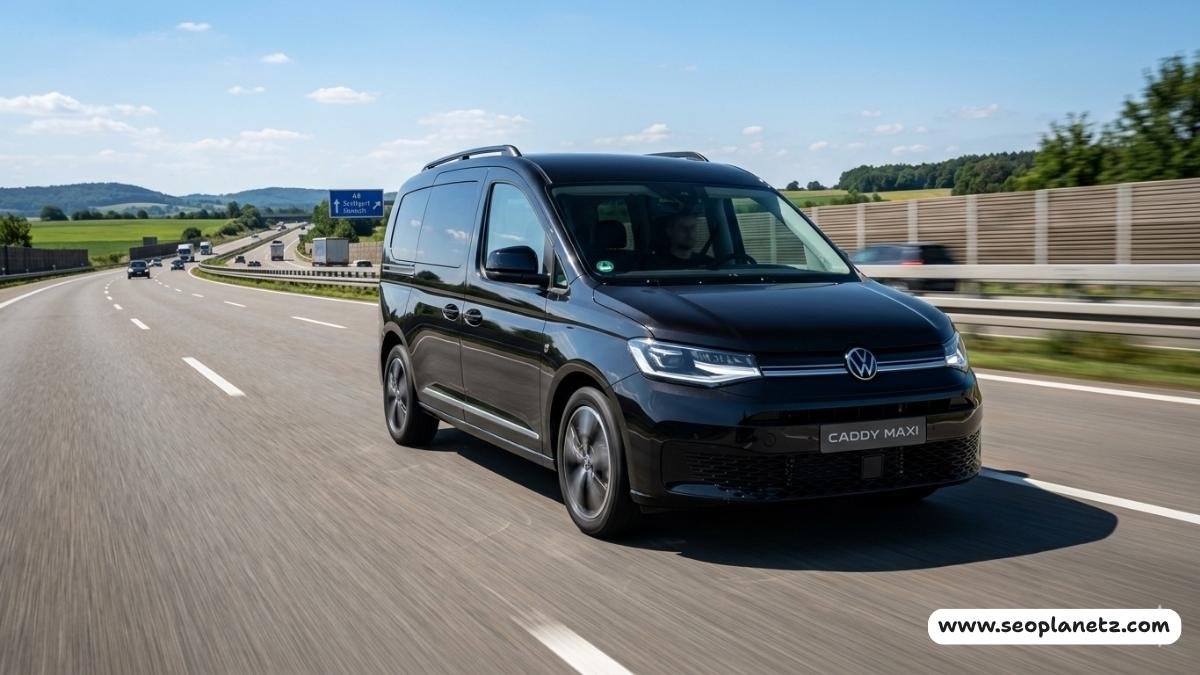
The 2026 Caddy Maxi is offered with three distinct powertrain options, catering to every buyer profile.
1.5 TSI Petrol (114 PS / 84 kW) This 1,498cc turbocharged four-cylinder produces 114 PS and 200 Nm of torque, mated to either a 6-speed manual or 7-speed DSG. Real-world 0–62 mph takes approximately 11.5 seconds. It’s the most affordable entry point and delivers relaxed, car-like performance for urban and suburban use.
2.0 TDI Diesel (102 PS or 122 PS / 320 Nm) The diesel is the workhorse. The 2.0-litre TDI develops up to 320 Nm of torque from just 1,750 rpm — exceptional for towing, motorway cruising, and loaded family runs. The top-spec TDI320 variant (90 kW) is available with DSG and optional 4MOTION AWD. Towing capacity hits 1,500 kg braked, 720 kg unbraked.
1.5 TSI eHybrid (148 PS / 350 Nm) — 2026 New Addition This is the headline powertrain for 2026. Combining a 1.5-litre TSI petrol with an electric motor, it delivers a combined 148 PS and 350 Nm of torque. The WLTP electric range is up to 122 km (72 miles), and total combined range exceeds 620 km. It’s purpose-built for urban zero-emission zones while retaining genuine long-distance capability.
Technical Specs Table Volkswagen Caddy Maxi
| Spec | 1.5 TSI Petrol | 2.0 TDI Diesel | 1.5 TSI eHybrid |
|---|---|---|---|
| Engine | 1.5L Turbo 4-cyl | 2.0L Turbo Diesel | 1.5L + Electric Motor |
| Power (PS) | 114 | 122 | 148 |
| Torque (Nm) | 200 | 320 | 350 |
| 0–62 mph | ~11.5 sec | ~10.9 sec | ~9.8 sec |
| Transmission | 6MT / 7DSG | 6MT / 7DSG | 7DSG |
| Top Speed | 174 km/h | 179 km/h | 181 km/h |
| Towing (braked) | 1,200 kg | 1,500 kg | 1,200 kg |
| Fuel Economy | 42.2 mpg | 52.3 mpg | ~470 mpg (PHEV) |
Interior Tech & Comfort Volkswagen Caddy Maxi
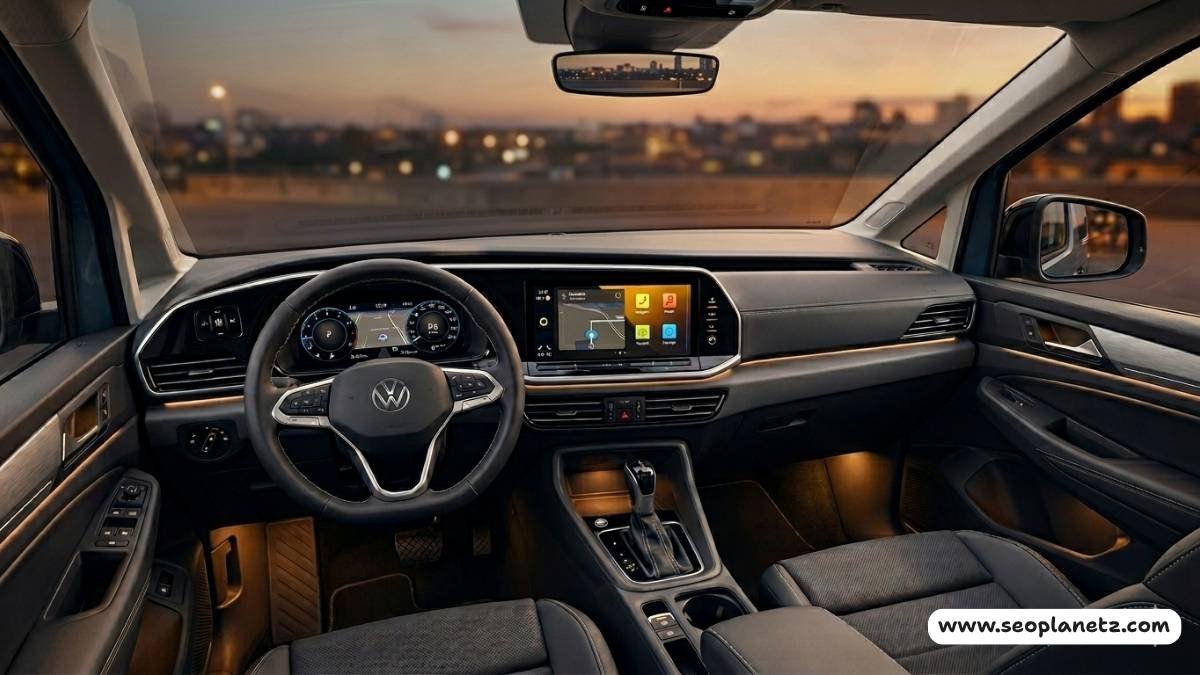
Stepping inside the 2026 Caddy Maxi, you immediately notice this is no ordinary van. The new free-standing central display gives the dashboard a distinctly modern feel, aligned with the latest VW passenger car lineup.
The standard Caddy trim includes a 10-inch touchscreen sat-nav, manual air conditioning, electric heated mirrors, height-adjustable front seat, and a full ADAS sensor suite. Upgrade to the Caddy Life variant and you unlock digital instrument dials, rear-view camera, keyless entry, under-seat drawers, lumbar adjustment, roof rails, Android Auto/Apple CarPlay, and 16-inch alloy wheels.
The 2026 model also brings optional 17- and 18-inch alloys, a panoramic glass roof, and the revised interior color palette. Material quality is noticeably above competitors — plastics feel firm but well-fitted, and the second-row seating is genuinely comfortable for three adults side by side.
One real frustration, however: the infotainment menus remain confusingly organized. There are no physical shortcut buttons to jump between functions, and even adjusting the radio volume through the screen rather than the steering wheel feels like a chore. The Touran’s system remains more intuitive for daily use.
Dimensions & Cargo Space Volkswagen Caddy Maxi
Dimension Table: Caddy vs Caddy Maxi
| Dimension | Caddy (SWB) | Caddy Maxi (LWB) |
|---|---|---|
| Length | 4,500 mm | 4,853 mm |
| Width | 1,855 mm | 1,855 mm |
| Height | 1,832 mm | 1,856 mm |
| Wheelbase | 2,762 mm | 2,970 mm |
| Boot (7 seats up) | 191 L | 446 L |
| Boot (rear seats folded) | 1,213 L | 1,452 L |
| Boot (all seats out) | 2,556 L | 3,105 L |
| Load Length (Cargo) | 1,797 mm | 2,150 mm |
| Payload (Cargo Maxi) | 687 kg | 700 kg |
The extra 353mm of length the Maxi carries over the standard Caddy directly benefits rear passenger legroom and boot volume. For families using all seven seats regularly, the Maxi is categorically the better choice — the standard wheelbase with seven seats up has a boot barely the size of a briefcase.
Trim Levels & Optional Features
Trim Comparison Table
| Feature | Caddy (Base) | Caddy Life | Caddy Style |
|---|---|---|---|
| Touchscreen | 10-inch | 10-inch | 10-inch |
| Digital Dials | No | Yes | Yes |
| Rear Camera | No | Yes | Yes |
| Apple/Android Auto | No | Yes | Yes |
| Keyless Entry | No | Yes | Yes |
| Alloys | 15″/16″ Steel | 16″ Alloy | 17″/18″ Alloy |
| Roof Rails | No | Yes | Yes |
| Under-seat drawers | No | Yes | Yes |
| Panoramic Roof | No | Optional | Optional |
| eHybrid Available | No | Yes | Yes |
| UK Price (approx.) | £31,500 | £33,897 | £36,500+ |
The Maxi adds approximately £1,400 across all trim levels compared to the standard wheelbase version.
Fuel Efficiency & Real-World MPG
What Is the Fuel Efficiency of the Volkswagen Caddy Maxi Diesel Engine?
The 2.0 TDI diesel returns an official WLTP figure of around 52 mpg combined. In real-world driving, expect 44–48 mpg on mixed routes and up to 52 mpg on long motorway runs with a light load. The 1.5 TSI petrol Maxi achieves 42.2 mpg combined under WLTP testing. The eHybrid in EV mode consumes 0.5 L/100km (effectively 470 mpg equivalent on WLTP methodology), making it exceptionally cheap to run for urban commuters who charge nightly.
Annual service interval: every 12 months or 15,000 km (VW-recommended). The 5-year unlimited-kilometre warranty (in Australia) and 3-year warranty in the UK add genuine ownership confidence.
Safety Suite & Crash Ratings
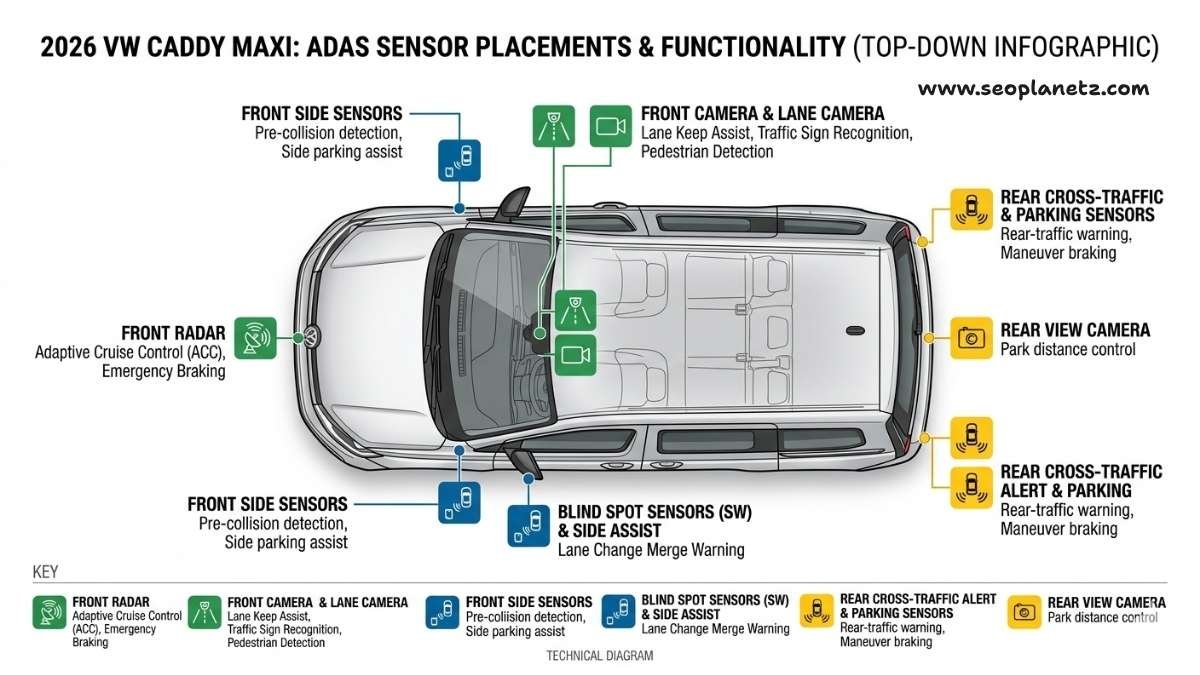
The 2026 Volkswagen Caddy Maxi carries a 5-star ANCAP safety rating and is equipped with one of the most comprehensive ADAS suites in its class:
- Front Assist (autonomous emergency braking with pedestrian/cyclist detection)
- Blind Spot Monitor
- Lane Keeping Assist
- Adaptive Cruise Control (optional)
- Rear Cross-Traffic Alert
- 9 airbags (including side curtain and driver knee airbag)
- 5 ISOFIX child anchor points
According to Euro NCAP’s official testing database, the platform shared with the current VW Golf has performed strongly across adult and child occupant protection categories. For families and fleet operators, this safety credentials package competes directly above its price class.
Competitor Comparison: How Does the Caddy Maxi Stack Up?
Competitor Comparison Table
| Vehicle | Length | Seating | Boot (max) | Petrol MPG | Price (UK from) |
|---|---|---|---|---|---|
| VW Caddy Maxi | 4,853 mm | 7 | 3,105 L | 42.2 mpg | £33,000 |
| Ford Tourneo Connect Grand | 4,843 mm | 7 | 2,936 L | 40.1 mpg | £31,500 |
| Citroën Berlingo XL | 4,753 mm | 7 | 3,000 L | 43.5 mpg | £29,995 |
| Toyota Proace City Verso L | 4,759 mm | 7 | 2,693 L | 44.2 mpg | £30,500 |
| Vauxhall Combo-e Life XL | 4,753 mm | 7 | 2,693 L | Electric | £37,000 |
The Caddy Maxi’s primary advantage over the Berlingo XL and Proace City is its Golf-derived MQB platform, which gives it genuinely car-like handling. The Ford Tourneo Connect Grand is its closest rival on space and price, and is arguably better value — but the VW commands stronger resale values across the UK used car market.
Also Read: 2026 Toyota Prius Review, Price, and Specs
What Are the Typical Fuel Economy Figures for This Extended Length Compact Van?
The Volkswagen Caddy Maxi diesel achieves around 44–52 mpg in real-world use depending on load and route. The petrol TSI returns 40–42 mpg combined. The eHybrid, when charged regularly, can cover urban commutes on electricity alone (up to 72 miles WLTP), dropping running costs dramatically for city-based users.
Driving Experience & Handling
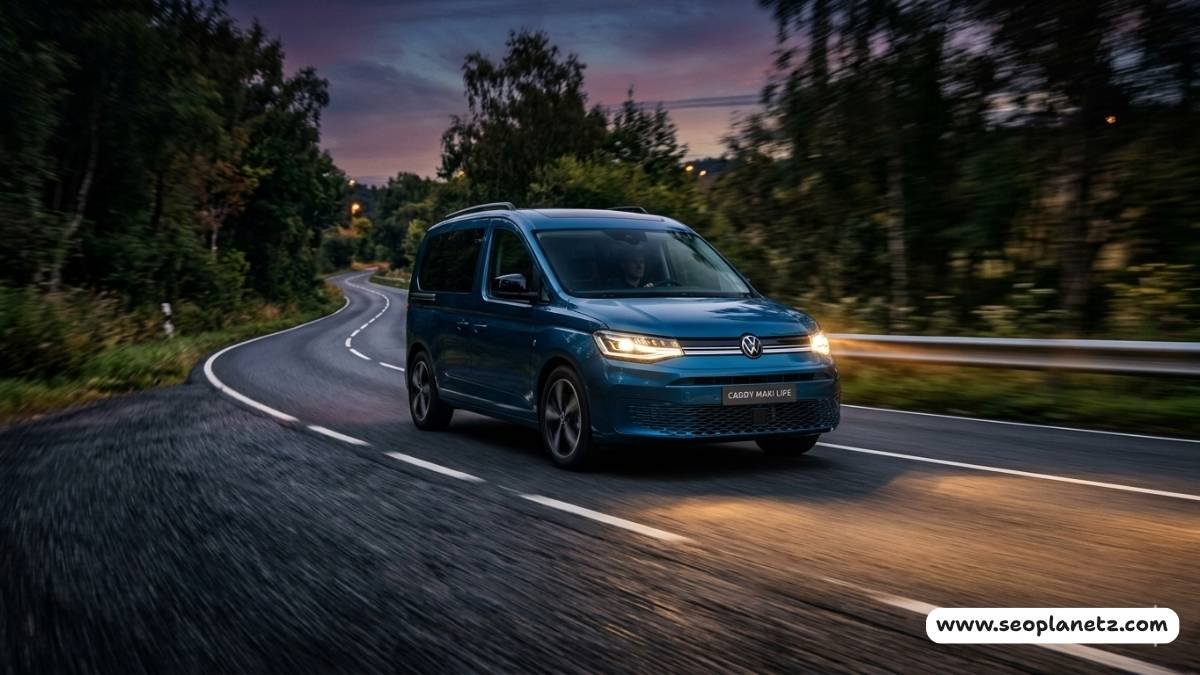
Behind the wheel, the Caddy Maxi consistently surprises first-time drivers. The MQB platform gives it accurate, well-weighted steering that feels entirely at odds with its van-like silhouette. Body roll is present but well-controlled, and the brakes inspire confidence even under heavy load.
In city traffic, the Maxi’s 4,853mm length requires awareness — tight multi-storeys and congested urban car parks are genuinely challenging. Visibility is excellent, but the rear tailgate needs significant clearance to open fully, which catches owners out in tight spaces.
On the motorway, the 2.0 TDI DSG combination is the most relaxed long-distance partner. The 320 Nm torque peak arrives early and sustains effortlessly at motorway speeds. NVH (noise, vibration, harshness) levels are acceptable rather than class-leading — wind noise above 70 mph is noticeable.
The 7-speed DSG can feel hesitant at very low speeds reversing uphill — a widely reported trait. Manual gearbox buyers have no such concern, but lose out on the smoother daily commuting experience the DSG generally provides.
Also Read: 2024 Ford Bronco Raptor Specs & Prices
Common Issues Reported by Owners About Volkswagen Caddy Maxi
This is where the Caddy Maxi’s “hidden problems” come into plain view. Every prospective buyer must read this section.
1. DSG Gearbox Hesitation (All Engines) The 7-speed dual-clutch DSG can exhibit hesitation when engaging reverse on a gradient. It may occasionally enter a fault mode requiring ignition cycling to reset. This is a widely documented trait across VW’s DSG-equipped range.
2. Diesel Injector Failures (Older 1.6 TDI — Pre-2015) On pre-2015 models, the 1.6 TDI injectors were chronically unreliable. Individual injector replacement costs run to £500–£700 each, and some owners faced three or four failures in sequence. VW updated the injector specification from approximately 2014 onwards. The current 2.0 TDI unit does not share this weakness and is considered far more reliable.
3. EGR Valve & DPF Fouling (Diesel Models) Short urban journeys are the enemy of any diesel particulate filter. Owners who predominantly drive under 5 miles in stop-start traffic report frequent DPF warning lights. A regular 30-minute motorway run clears the filter, but city-only diesel Caddy drivers should strongly consider switching to the petrol TSI or eHybrid instead.
4. ECU / Engine Management Faults The Bosch EDC16 ECU fitted to older Caddy diesel variants has a documented failure mode where the engine will not start, the engine management light does not illuminate, and fault codes cannot be read. This requires professional ECU rebuild or replacement.
5. Power Steering Failure A small but consistent number of owners have reported power steering failure — particularly in higher-mileage examples. This is a significant safety concern and warrants immediate professional inspection if any unusual steering resistance develops.
6. Infotainment Menu Complexity Not a mechanical fault, but universally flagged in owner reviews: the touchscreen interface lacks physical shortcut buttons, making routine tasks like volume adjustment needlessly fiddly during driving.
7. Clutch Wear in City Traffic (Manual Models) The dual-mass flywheel clutch on manual variants is susceptible to accelerated wear under heavy city stop-start use. Pedal travel exceeding 145mm indicates wear. Replacing the hydraulic fluid every four years can extend clutch life by up to 30%.
For full fault code support and ECU diagnostics, Volkswagen’s official service network provides the most accurate recourse.
Also Read: 2025 Mercedes-Benz GLE-Class Prices, Specs and Review
Where Can I Find Reviews for the Volkswagen Caddy Maxi?
Authoritative reviews are available at RAC Drive, What Car?, Parkers, and Carbuyer. For real owner experiences, ProductReview.com.au and the dedicated owner forum CADDY2K.com provide unfiltered long-term ownership accounts. We also recommend the DVLA vehicle approval registry for UK registration and safety compliance records.
Pros & Cons
✅ Pros:
- Genuinely car-like handling from the MQB/Golf platform
- Best-in-class seating flexibility — up to 3,105 litres with seats out
- eHybrid powertrain is a genuine 2026 game-changer for urban users
- Strong resale values outperform Berlingo, Combo-e rivals
- 5-star ANCAP safety rating with comprehensive ADAS
- 5-year unlimited-km warranty (selected markets)
- Outstanding as a camper conversion base (Caddy California)
❌ Cons:
- Long tailgate needs clearance — tight car parks are a problem
- Confusing infotainment with no physical shortcut buttons
- DSG hesitation reversing on hills
- No plug-in hybrid option on base trims
- Diesel variants suffer DPF issues in short-journey urban use
- Higher price than Berlingo XL / Tourneo Connect equivalents
- No electric-only variant (unlike e-Berlingo, Combo-e rivals)
Wait or Buy? 2025 vs 2026 Model Analysis
If you’re sitting on the fence, the answer in 2026 is: buy now. The 2026 refresh is the most substantial update the fifth-generation Caddy has received. The new eHybrid powertrain alone makes it a fundamentally different proposition for buyers in low-emission zones or with workplace charging access.
The 2025 model still represents solid value on the used market — particularly the TDI320 DSG Life. But if you’re buying new, the 2026’s new free-standing display, updated exterior, and 18-inch alloy option make it the definitive spec to go for.
One caveat: if diesel is your preferred fuel and you’re a mainly motorway driver, the outgoing 2025 TDI is available with heavy dealer discounts right now. That’s worth factoring in.
Also Read: 2026 Nissan Rogue: Is the New Rock Creek Edition Worth It?
Compare Running Costs for Similar Sized Vehicles (UK Market)
| Vehicle | Annual Fuel Cost* | Annual Insurance | Annual Service | 3-Year TCO Est. |
|---|---|---|---|---|
| VW Caddy Maxi 2.0 TDI | £1,350 | £820 | £420 | £7,770 |
| VW Caddy Maxi 1.5 eHybrid | £480** | £840 | £440 | £5,280** |
| Ford Tourneo Connect Grand | £1,420 | £760 | £380 | £7,680 |
| Citroën Berlingo XL Diesel | £1,310 | £720 | £350 | £7,140 |
| Vauxhall Combo-e Life XL | £320 (electric) | £870 | £290 | £4,440 |
*Based on 12,000 miles/year, current UK fuel prices. **Assumes nightly home charging covers 60% of miles.
The eHybrid Caddy Maxi makes a compelling total cost of ownership case despite the higher purchase price, particularly for higher-mileage users.
Which Companies Offer Leasing Options for the Volkswagen Caddy Maxi?
In the UK, personal contract hire (PCH) and business leasing on the Caddy Maxi is available through Volkswagen Financial Services, LeasePlan, Lex Autolease, Motability (for eligible drivers), and most main VW dealers. Business contract hire rates on the TDI Life Maxi typically start from approximately £350–£400 +VAT per month on a 36-month, 10,000 mile/year deal. The eHybrid attracts lower Benefit-in-Kind (BIK) tax rates, making it particularly attractive for company car drivers.
Also Read: Kia K5 GT Line Specs & Prices: Complete 2026 Guide
Total Cost of Ownership Summary
- Purchase Price (UK): £31,500 – £38,000 (new)
- Annual Service Cost: ~£380–£450
- Road Tax (VED): £0–£190/year depending on CO2 (eHybrid qualifies for lowest band)
- Insurance Group: Groups 18–24 (one of the cheapest in its class)
- Resale Value (3yr/36k miles): Approximately 45–52% of new price
- Tyres: 195/65 R16 standard; ~£90–£130 per tyre
Frequently Asked Questions
Q: What is a VW Caddy called in America?
The VW Caddy is not officially sold in the United States under that name. In North America, the equivalent van-based MPV segment is served by larger vehicles like the Chrysler Pacifica or Kia Carnival. Caddy sales are primarily concentrated in Europe, Australia, and select Asian markets.
Q: What is the most common problem with a VW Caddy?
On older pre-2015 models, diesel injector failure on the 1.6 TDI engine is the most documented issue, with individual replacements costing £500–£700 each. On current MQB-platform models (2021 onwards), DSG gearbox hesitation at low speeds and infotainment complexity are the most frequently cited owner complaints.
Q: What is a VW Caddy Maxi?
The Caddy Maxi is the extended-wheelbase version of the Volkswagen Caddy, measuring 4,853mm in length — 353mm longer than the standard model. It seats seven as standard, offers a boot capacity of up to 3,105 litres with all seats removed, and shares the MQB platform with the VW Golf. It functions as a family MPV, light commercial van, and camper base.
Q: Can you live full-time in a Caddy Camper?
The factory Caddy California (based on the Maxi) is purpose-engineered for short breaks with a pop-up roof, mini kitchen, and sleeping platform. Full-time living is possible with aftermarket conversion but the Caddy’s space is limited versus a Transporter California. Most full-timers use it as a solo or couple’s van with careful kit selection. Electric range from the eHybrid also extends off-grid viability.
Q: Can you sleep in a Caddy Maxi?
Yes. With the rear seats removed, the Caddy Maxi offers a flat floor measuring approximately 2.15 metres in length — sufficient for most adults to lie flat. The standard Caddy’s 1.797m load length is borderline for taller users, making the Maxi the preferred choice for sleeping. The Caddy California factory conversion adds insulation, a pop-up roof, and fold-flat sleeping.
Q: Why is the new Volkswagen Caddy called the “Caddy 5”?
The latest Volkswagen Caddy is called the Caddy 5 because it represents the fifth generation of this iconic van. While some older sources might group previous facelifts together, Volkswagen officially launched the “Caddy 5” (Typ SB) in 2020.
Q: Can the Caddy handle heavy traffic?
Yes, though with caveats. The Caddy Maxi handles urban congestion well thanks to its car-derived MQB platform, responsive steering, and compact(ish) footprint for a 7-seater. The DSG automatic is the better choice for stop-start driving. The main challenge is the long tailgate — you need rear clearance — and the 4.85m length makes tight urban car parks more demanding than a standard hatchback.
Also Read: 2026 Honda Civic Type R Specs, Features and Prices
Final Verdict
The 2026 Volkswagen Caddy Maxi is the best version of this vehicle yet. The eHybrid powertrain transforms it from a smart-but-conventional family hauler into a genuinely future-proof purchase. The 7-seat layout, 3,105-litre maximum load space, Golf-sharp handling, and improved ADAS package make it the most capable compact MPV in Europe today.
Yes, the infotainment is frustrating. Yes, diesel variants need careful use to avoid DPF problems. And yes, it costs more than a Berlingo XL or Tourneo Connect.
But no rival offers this vehicle’s combination of car-like driving dynamics, maximum seating flexibility, camper conversion potential, and class-leading resale values in a single package. For large families, tradespeople who double as weekend adventurers, and urban fleet operators, the Caddy Maxi remains the benchmark.