10 Most Common Engine Misfire Causes in 2026

Introduction
Engine misfire causes more driver anxiety than almost any other car problem — and for good reason. When your engine misfires, one or more cylinders fail to combust fuel properly, resulting in rough running, power loss, and potential long-term engine damage.
According to the U.S. Environmental Protection Agency (EPA), a single misfiring cylinder can increase harmful emissions by up to 300%, making it both an environmental and mechanical concern. Whether you're noticing engine misfire symptoms at idle, during acceleration, or only under load, identifying the root cause quickly is essential. This guide breaks down all 10 major engine misfire causes in plain language, along with repair costs, diagnostic tips, and everything you need to know to get your car running smoothly again in 2026.
What Is an Engine Misfire?
An engine misfire happens when a cylinder doesn't complete the combustion cycle correctly. Instead of a clean ignition of the air-fuel mixture, combustion either doesn't happen at all (a "dead" misfire) or happens at the wrong time. The engine's ECU (Engine Control Unit) detects this and typically triggers a check engine light — often with diagnostic codes like P0300 (random misfire) or P0301–P0308 (cylinder-specific misfire).
Engine misfire causes vibration that you can feel through the steering wheel, floor, or seat. The rougher the misfire, the more severe the underlying problem. Catching it early is always cheaper than waiting.
Also Read: 2017 Honda Civic Review, Price, and Specs10 Most Common Engine Misfire Causes
1. Worn or Fouled Spark Plugs
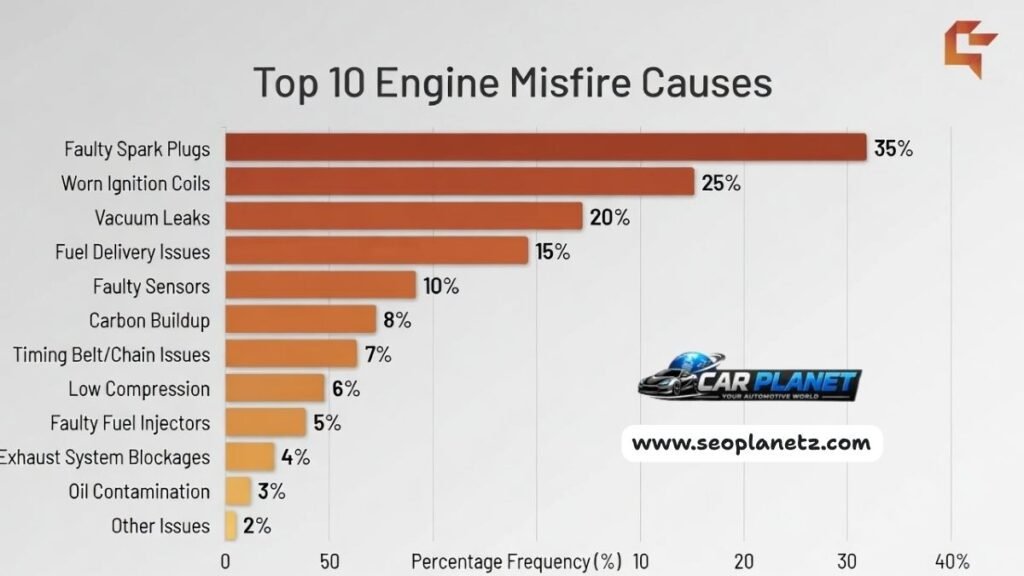
Spark plugs are the most frequent of all engine misfire causes. Each plug fires thousands of times per minute, and over time the electrode wears down, the gap widens, and the plug simply can't generate a strong enough spark. Fouled plugs — coated in oil, carbon, or fuel — cause the same result.
Spark plugs should typically be replaced every 30,000–100,000 miles depending on plug type. Spark plug replacement cost ranges from $50 to $250 for most vehicles, making this one of the most affordable fixes. The Car Care Council recommends checking spark plugs at every major service interval.
2. Faulty Ignition Coils
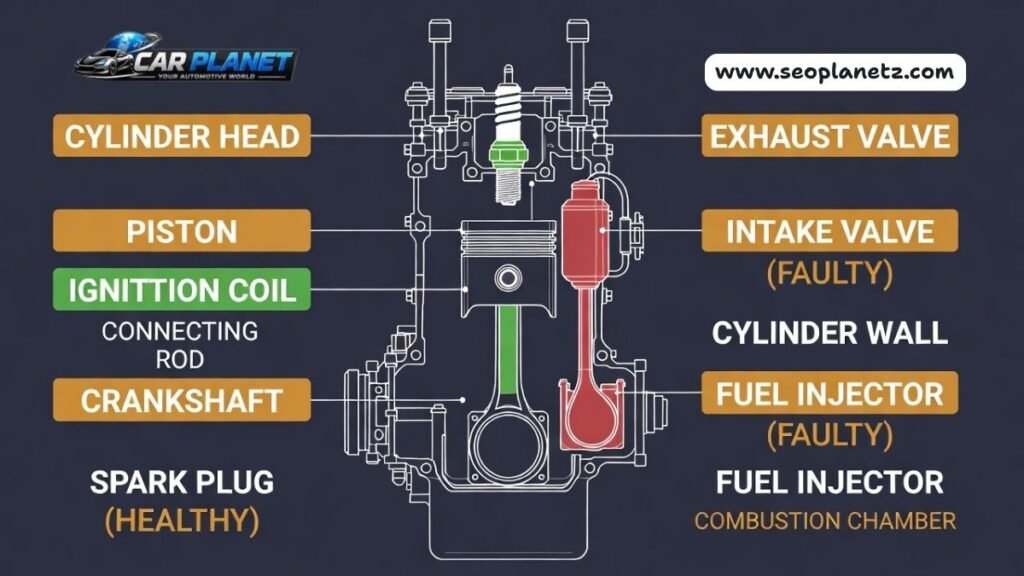
Modern engines use individual coil-on-plug (COP) ignition coils that sit directly on each spark plug. When a coil fails, the cylinder it serves loses its ignition source entirely — producing a consistent, cylinder-specific misfire. This is one of the most common engine misfire causes in vehicles made after 2000.
A bad ignition coil typically triggers a P030X code corresponding to the affected cylinder. Replacement costs range from $150 to $400 depending on the vehicle.
Also Read: How to Jump a Car Safely and Correctly in 20263. Clogged or Failing Fuel Injectors
Fuel injectors spray a precise mist of fuel into each cylinder. When an injector clogs, leaks, or fails electrically, the air-fuel ratio in that cylinder goes off balance — causing an engine misfire. This is a particularly common diesel engine misfire cause, as diesel injectors operate under much higher pressure and are more sensitive to fuel quality.
You can often clear minor injector deposits with a quality fuel injector cleaner, but severely clogged injectors require professional cleaning or replacement.
4. Low Fuel Pressure
When the fuel pump weakens or the fuel pressure regulator fails, the engine doesn't receive enough fuel to maintain proper combustion. The result is engine misfire when accelerating, since acceleration demands a sudden increase in fuel delivery that a weakened pump can't sustain.
Low fuel pressure is diagnosed using a fuel pressure gauge. The National Institute for Automotive Service Excellence (ASE) recommends testing fuel pressure as part of any comprehensive misfire diagnosis.
5. Vacuum Leaks
The intake manifold and its gaskets create a sealed pathway for the air-fuel mixture. A crack, loose connection, or failed gasket introduces unmetered air into the system — leaning out the mixture in affected cylinders and causing engine misfire at idle especially. Vacuum leaks often produce a hissing sound and a rough idle that smooths out at higher RPMs.
Also Read: How to Used Toyota RAV4 Complete Buyer’s Guide 20266. Low Compression
Every cylinder needs adequate compression to ignite the air-fuel mixture effectively. Worn piston rings, a damaged cylinder wall, or a burned valve all reduce compression — and low compression in any cylinder is a direct engine misfire cause. This is typically diagnosed with a compression test or leak-down test.
Low compression is a more serious issue because it often signals significant internal engine wear. Repair costs can range from $500 to $3,000+ depending on severity.
7. Blown Head Gasket
A blown head gasket is one of the most serious engine misfire causes. When the gasket fails between two cylinders, compression from one cylinder leaks into another, disrupting combustion in both. Coolant can also enter the cylinders, causing misfires accompanied by white smoke from the exhaust and overheating.
Head gasket repair is among the most expensive fixes — typically $1,000 to $2,500 in labor alone. Early diagnosis is critical to prevent total engine failure.
8. Bad Mass Airflow (MAF) Sensor
The MAF sensor measures the amount of air entering the engine and tells the ECU how much fuel to inject. A dirty or failing MAF sensor sends incorrect data, causing the engine to run too rich or too lean — both of which are engine misfire causes. Symptoms include rough idle, poor fuel economy, and engine misfire symptoms that appear inconsistently.
Cleaning the MAF sensor with specialized cleaner often resolves the issue. Replacement costs $150–$400 if cleaning doesn't help.
Also Read: AWD vs FWD in 2026: What’s the Difference Between Them?9. Faulty Crankshaft or Camshaft Position Sensor
These sensors tell the ECU the exact position of the crankshaft and camshaft at all times, allowing it to time fuel injection and ignition precisely. When either sensor fails, the timing goes off — causing engine misfire, especially during startup or at varying RPMs. This is also a common what causes engine misfire at idle scenario.
10. EGR Valve Problems
The Exhaust Gas Recirculation (EGR) valve recirculates a portion of exhaust gases back into the intake to reduce emissions. A stuck-open EGR valve dilutes the intake charge with inert exhaust gases, causing lean misfires — particularly under light load and at idle. This is a frequent diesel engine misfire cause and also affects many gasoline engines.
Engine Misfire Symptoms: How to Recognize the Problem
Before you can fix the issue, you need to recognize the warning signs. The most common engine misfire symptoms include:
- Rough or shaking idle — the engine shakes noticeably when stopped
- Check engine light — often flashing, which indicates an active misfire
- Loss of power — especially noticeable during engine misfire when accelerating
- Poor fuel economy — incomplete combustion wastes fuel
- Strong fuel smell from the exhaust — unburned fuel exiting the system
- Unusual sounds — popping, sputtering, or backfiring from the engine
A flashing check engine light is particularly serious — it means the misfire is severe enough to damage the catalytic converter. Pull over and have the vehicle inspected immediately.
Engine Misfire Causes: Diagnostic Code Reference Table
| OBD-II Code | Meaning | Common Cause |
|---|---|---|
| P0300 | Random/Multiple Misfire | Low fuel pressure, vacuum leak |
| P0301 | Cylinder 1 Misfire | Spark plug, ignition coil |
| P0302 | Cylinder 2 Misfire | Fuel injector, low compression |
| P0303 | Cylinder 3 Misfire | Ignition coil, spark plug |
| P0304 | Cylinder 4 Misfire | Fuel injector, valve issue |
| P0316 | Misfire on Startup | Crankshaft sensor, compression |
| P0351–P0358 | Ignition Coil Circuit Fault | Faulty coil pack |
You can read these codes with an OBD-II scanner, available for as little as $20–$50. The EPA's OBD-II resources page explains how the onboard diagnostic system works in detail.
Engine Misfire Cost: What to Expect to Pay
| Repair | DIY Difficulty | Average Cost |
|---|---|---|
| Spark Plug Replacement | ⭐ Easy | $50–$250 |
| Ignition Coil Replacement | ⭐⭐ Moderate | $150–$400 |
| Fuel Injector Cleaning | ⭐ Easy | $50–$150 |
| Fuel Injector Replacement | ⭐⭐⭐ Hard | $300–$900 |
| MAF Sensor Replacement | ⭐⭐ Moderate | $150–$400 |
| Vacuum Leak Repair | ⭐⭐ Moderate | $100–$400 |
| Compression/Ring Repair | ⭐⭐⭐⭐ Expert | $500–$3,000+ |
| Head Gasket Repair | ⭐⭐⭐⭐ Expert | $1,000–$2,500+ |
| EGR Valve Replacement | ⭐⭐ Moderate | $200–$600 |
| Crankshaft Position Sensor | ⭐⭐ Moderate | $150–$300 |
For independent cost estimates and repair guidance, Consumer Reports and RepairPal are reliable resources to benchmark local mechanic pricing.
How to Fix Engine Misfire Quickly: Step-by-Step
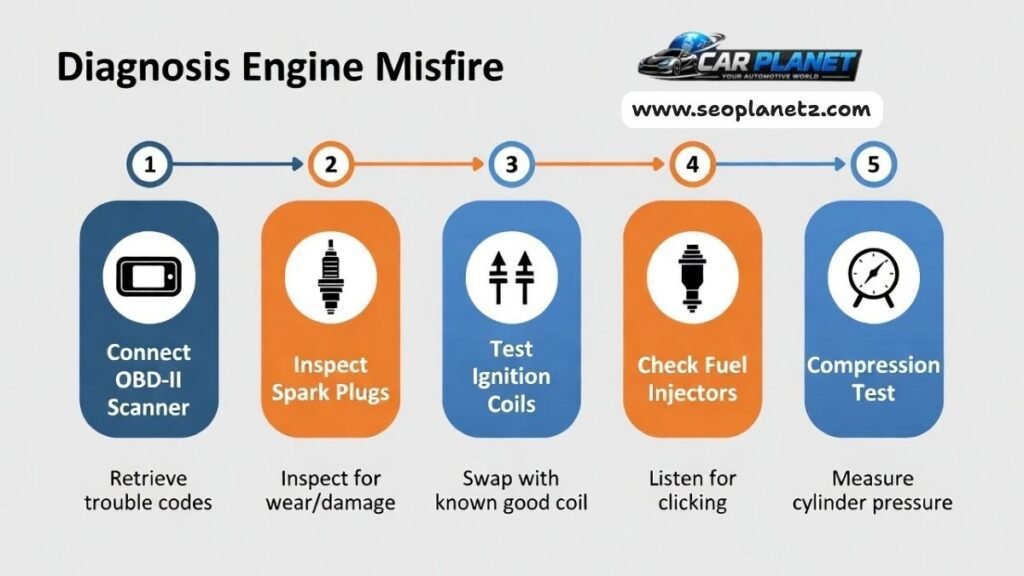
If you want to know how to fix engine misfire quickly, follow this diagnostic sequence before spending money on parts:
Step 1: Read the OBD-II Codes
Connect a scanner to the OBD-II port (under the dashboard, driver's side). Note all codes — especially cylinder-specific ones like P0301 or P0304, which point directly to the problem cylinder.
Step 2: Inspect the Spark Plugs First
Remove the spark plugs from each cylinder and inspect them. Black, sooty plugs indicate a rich mixture. White or chalky plugs suggest a lean condition or overheating. Worn or cracked plugs should be replaced immediately — this alone fixes a large percentage of misfire cases.
Also Read: Do Electric Cars Have Transmissions in 2026? The Complete GuideStep 3: Swap the Ignition Coil
If the spark plugs look fine, swap the ignition coil from the misfiring cylinder to a known-good cylinder. If the misfire code follows the coil to its new location, the coil is faulty. This is a quick, no-cost diagnostic step.
Step 4: Check Fuel Injectors
Listen to each injector with a mechanic's stethoscope or a screwdriver pressed against the injector body. Each should produce a steady clicking sound. A silent injector is likely dead or clogged.
Step 5: Test Compression
If the above checks don't resolve the issue, perform a compression test. Healthy compression should be 150–200 PSI in most gasoline engines. A cylinder reading below 100 PSI points to internal wear — rings, valves, or a gasket problem.
Can You Drive With an Engine Misfire?
This is one of the most common questions drivers ask — and the answer is: it depends on severity. A minor, occasional misfire may allow you to drive a short distance to a mechanic. But a severe or consistent misfire is a different story entirely.
Driving with a serious engine misfire risks:
- Catalytic converter damage (very expensive — $1,000–$3,000 to replace)
- Hydrocarbons flooding the exhaust system
- Oil contamination from unburned fuel washing cylinder walls
- Progressive internal engine damage
If the check engine light is flashing, stop driving as soon as safely possible. A steady check engine light with minor symptoms allows cautious driving — but get it diagnosed the same day. The National Highway Traffic Safety Administration (NHTSA) advises drivers not to ignore illuminated warning lights.
Diesel Engine Misfire Causes: Special Considerations
Diesel engines misfire for some of the same reasons as gasoline engines but have unique factors too. The most common diesel engine misfire causes include:
- Injector wear or failure — diesel injectors operate at 20,000+ PSI and wear more quickly
- Glow plug failure — glow plugs pre-heat the combustion chamber in cold conditions; a failed plug causes hard starting and misfires
- Air in the fuel system — a small air leak in diesel fuel lines causes intermittent, frustrating misfires
- Low cetane fuel — poor-quality diesel with low cetane rating causes incomplete combustion
- Fuel filter clogging — diesel fuel picks up more particulate contamination than gasoline, making filter maintenance critical
Diesel misfire diagnosis often requires specialized equipment. The U.S. Department of Energy's Alternative Fuels Station locator can also help diesel owners find quality fuel sources.
Also Read: How Long Do Car Batteries Last? 7 Critical Facts You Need to KnowKey Takeaways
Here's a quick summary of everything you need to know about engine misfire causes:
- Engine misfire causes include spark plugs, ignition coils, fuel injectors, vacuum leaks, low compression, blown head gaskets, MAF sensor faults, position sensor failures, and EGR valve problems
- A flashing check engine light means the misfire is severe — stop driving immediately
- The most cost-effective first step is always inspecting and replacing spark plugs
- Diesel engine misfire causes differ slightly — focus on injectors, glow plugs, and fuel quality
- Engine misfire cost ranges from $50 (spark plugs) to $2,500+ (head gasket), depending on the cause
- Always read OBD-II codes before replacing parts to avoid unnecessary spending
- Ignoring a misfire accelerates engine damage and risks destroying the catalytic converter
Frequently Asked Questions
Q: How do you fix a misfiring engine?
Start by reading the OBD-II diagnostic codes with a scanner to identify the affected cylinder. Then inspect spark plugs, test ignition coils, check fuel injectors, and perform a compression test in that order. Many engine misfires are resolved simply by replacing worn spark plugs or a faulty ignition coil — both affordable repairs you can often do yourself.
Q: What are the most common engine misfire causes?
The most common engine misfire causes are worn spark plugs, failed ignition coils, and clogged fuel injectors. These three issues account for the majority of misfire cases in both gasoline and diesel engines. Vacuum leaks and low compression are also frequent culprits, especially in older or high-mileage vehicles.
Q: Can I still drive if my engine is misfiring?
You can drive briefly with a mild misfire, but it's not recommended. A severe or consistent misfire — especially one that makes the check engine light flash — can damage your catalytic converter and cause progressive internal engine damage. Drive only to reach a mechanic, and avoid highway speeds or heavy acceleration until the problem is fixed.
Q: Is it expensive to fix an engine misfire?
Engine misfire cost varies widely. Simple fixes like spark plug replacement cost $50–$250 and are often DIY-friendly. More complex repairs like head gasket replacement can run $1,000–$2,500 or more. The key is diagnosing the exact engine misfire cause early — catching it at the spark plug stage is far cheaper than letting it escalate to compression loss.
Q: What causes engine misfire at idle specifically?
Engine misfire at idle is most commonly caused by vacuum leaks, a faulty EGR valve, dirty fuel injectors, or a bad crankshaft/camshaft position sensor. At idle, the engine operates on a very lean, precise mixture — so even small disruptions in air, fuel, or timing cause noticeable roughness that smooths out at higher RPMs.
Q: Does engine misfire cause vibration?
Yes — engine misfire causes vibration that you can feel through the steering wheel, seat, or floor. The vibration occurs because one or more cylinders are not firing consistently, creating an imbalanced power stroke. The more cylinders misfiring, the more severe the shaking. Multiple cylinder misfires (code P0300) produce the most intense vibration.
Q: What are diesel engine misfire causes?
Diesel engine misfire causes include worn fuel injectors, failed glow plugs, air in the fuel system, a clogged fuel filter, and low-cetane fuel. Diesel engines rely on compression ignition rather than spark plugs, so glow plugs and injector condition are especially critical to smooth combustion.
Also Read: 2025 Ford Edge Complete Guide to Price, Features, and SpecsConclusion
Understanding engine misfire causes is the difference between a $50 spark plug fix and a $2,000 head gasket repair. The engine misfires for a reason — and that reason almost always gets worse the longer it's ignored. Whether you're dealing with engine misfire when accelerating, at idle, or only under specific conditions, the 10 causes outlined in this guide cover the vast majority of real-world scenarios.
Start with the basics: read the fault codes, check your spark plugs, and test your ignition coils. Most engine misfire causes can be resolved without expensive specialist tools if caught early. For complex issues like compression loss or head gasket failure, always consult an ASE-certified mechanic. Addressing engine misfire causes promptly protects your engine, your wallet, and your safety on the road.