
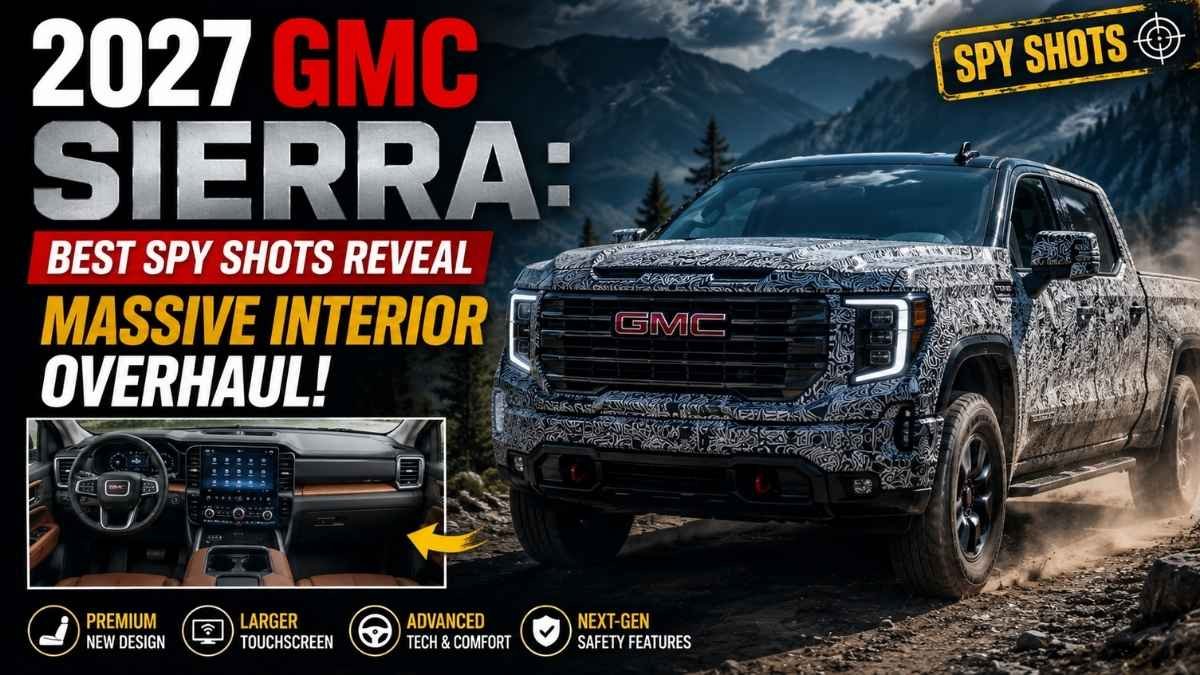
2027 GMC Sierra 1500 Redesign
Quick Summary: What You Need to Know:-
-
What is it? The 2027 GMC Sierra 1500 is a complete fifth-generation (5th Gen) redesign built on GM’s updated T1-2 body-on-frame architecture.
-
Major Upgrades: Heavy camouflage prototypes and interior spy shots confirm a massive landscape-oriented touchscreen infotainment display, a column-mounted electronic stalk shifter, and a fully digital cockpit overhaul.
-
Powertrain News: Alongside the Gen 6 Small Block V8 engine family and 3.0L Duramax Turbo-Diesel, a highly anticipated Plug-In Hybrid (PHEV) variant is in development to compete directly with Ford’s F-150 PowerBoost.
-
Timeline: Closed-door dealer reveals point to an official public debut in Fall 2026, with production at the Fort Wayne Assembly plant starting for early 2027 customer deliveries.
The 2027 GMC Sierra isn’t just a refresh — it’s a statement. If you are planning to sign paperwork for a new full-size pickup truck in 2026, pause immediately. Leaked spy shots of the next-gen Sierra prove that buying the current model right now might be an expensive, fast-depreciating mistake.
Multiple rounds of 2027 GMC Sierra interior spy shots—captured by photographers from Car and Driver, GM Authority, CarBuzz, and GM-Trucks.com—confirm that the digital cockpit is essentially finished, the engine options are locked in, and the luxury trim hierarchy is fully defined.
📌 Section Summary: 2027 GMC Sierra 1500 is a full fifth-generation redesign on the T1-2 platform. Spy shots confirm landscape infotainment screen, physical buttons, column shifter, digital gauge cluster, and expected PHEV option. Reveal expected fall 2026.
2027 GMC Sierra Release Date — Timeline and What to Expect
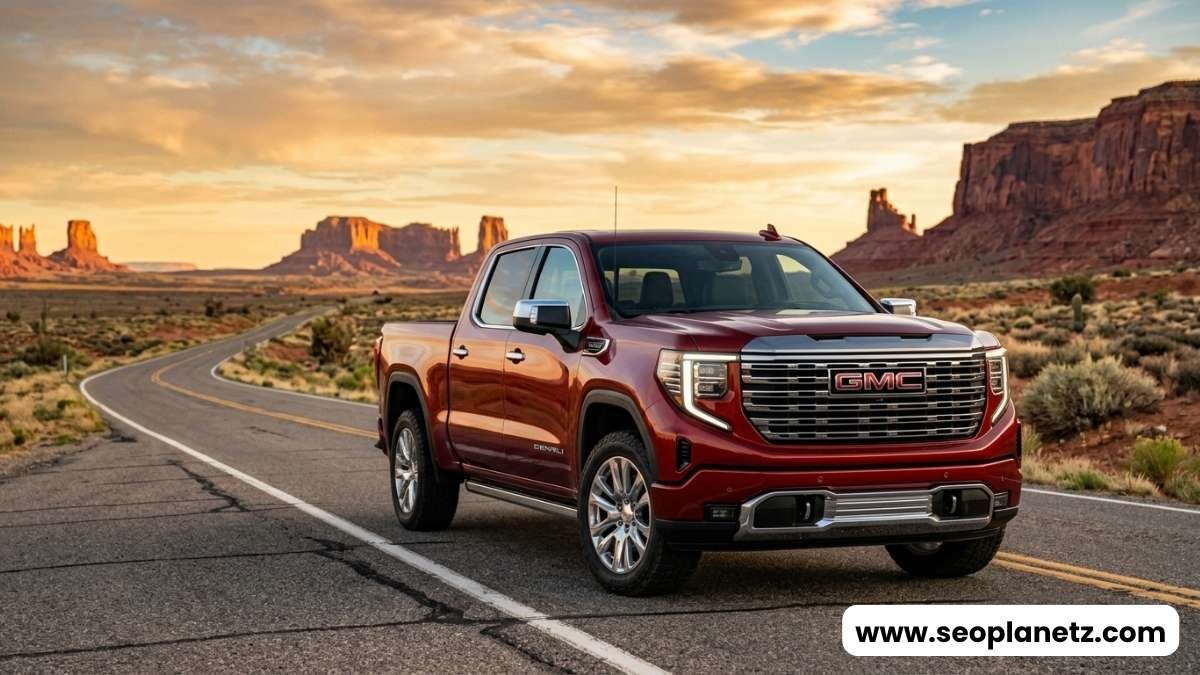
The 2027 GMC Sierra release date follows a predictable pattern based on GM’s product launch history and current prototype activity. A closed-door dealer reveal has reportedly already occurred — an event GMC typically holds four to six months before the public unveil. That puts the official reveal squarely in fall 2026, with production at GM’s Fort Wayne, Indiana assembly plant beginning shortly after.
For buyers tracking the 2027 GMC Sierra release date, the fall 2026 window is the most reliable target based on all current intelligence.
Customer deliveries are expected in early-to-mid 2027, following the traditional model-year rollout cadence. The 2026 Sierra 1500 currently in showrooms represents the final iteration of the outgoing generation — a truck that has served GMC well but is now clearly showing its age against a Ram 1500 interior that raised the bar significantly in recent years.
Pricing has not been officially announced. Based on current Sierra pricing structure and expected content upgrades, realistic estimates place the base Pro trim around $40,000–$44,000 and the Denali Ultimate above $82,000. Between those bookends, buyers will have more trim options than any previous Sierra generation.
2027 GMC Sierra Interior Spy Shots — Engineering Analysis
For the infotainment system, the prototype features a landscape-oriented touchscreen display paired with a physical volume knob. The cockpit architecture showcases a complete digital cockpit overhaul equipped with a flat-bottom steering wheel and an integrated Super Cruise indicator bar. To maximize console space, a column-mounted stalk shifter replaces the traditional center console shifter, creating ample room for a dual wireless charging slot space.
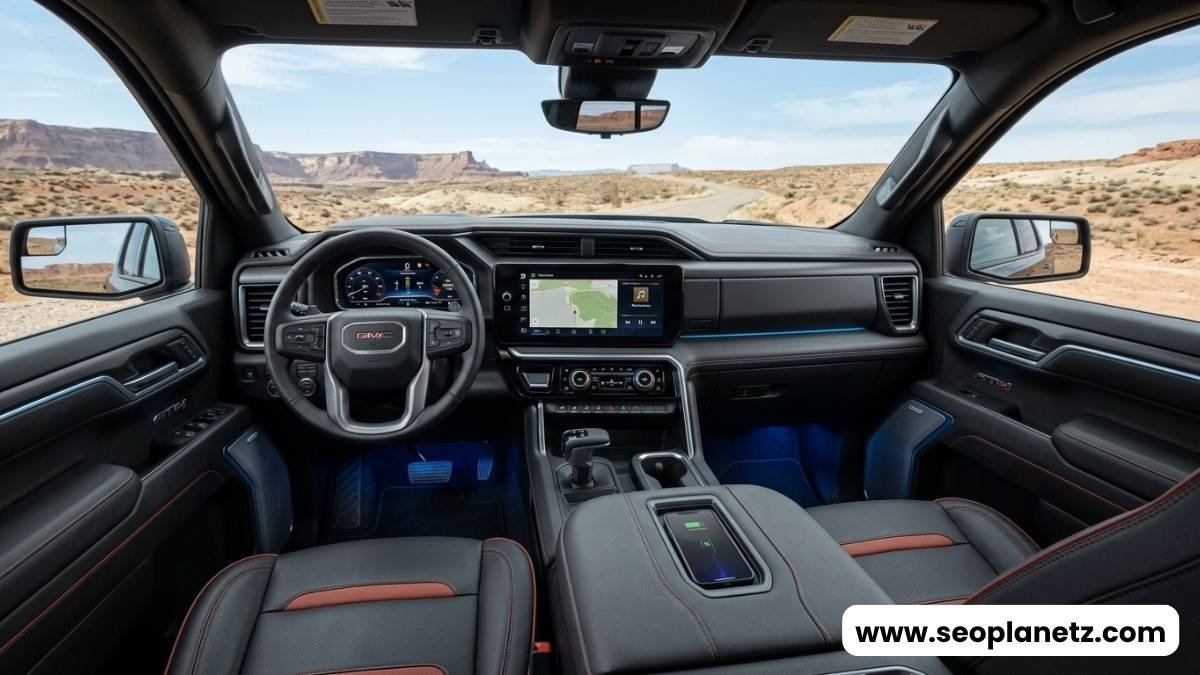
The 2027 GMC Sierra interior spy shots tell a very deliberate engineering story. Rather than borrowing the vertical screen configuration from the GMC Yukon or Sierra EV, GMC has developed a completely unique layout for the 1500 — one that prioritizes horizontal real estate and physical control accessibility over visual drama.
At the center of the dashboard sits a large landscape-oriented infotainment display that stretches well past the center stack. Early analysis suggests the footprint is comparable to the 33-inch curved display found in the 2021–2024 Cadillac Escalade, though whether the Sierra’s panel adopts a similar curve remains unconfirmed from prototype images alone.
Below that screen is where GMC makes its boldest statement: a dedicated row of physical rocker and toggle switches for climate controls, drive mode selection, and trailer brake settings. This is not an accidental design choice. It’s a direct response to years of owner feedback — and competitive intelligence — showing that touchscreen-only climate controls frustrate truck owners more than almost any other interior feature.
The transmission shifter has moved back to the steering column, mirroring the setup already found in the Sierra EV. This single change frees up the entire center console, creating noticeably expanded storage real estate including multiple cubbies and what prototype imagery strongly suggests are dual wireless charging slots.
The steering wheel itself is the flat-bottom unit carried over from the Sierra EV, fitted with bright trim surrounds at the 9 and 3 o’clock multifunction control positions. Higher trims will add the Super Cruise indicator bar — which is visibly absent on the base Pro prototype, providing one of the clearest trim-level differentiators captured in spy shots to date.
Even the base Pro trim gets a fully digital gauge cluster — replacing the six-gauge analog unit that made the outgoing Pro feel outdated from the moment you sat down. This upgrade alone transforms the entry-level Sierra experience in ways that are difficult to overstate.
📌 Interior Highlights: Landscape infotainment screen | Digital gauge cluster | Column-mounted e-shifter | Physical rocker switches | Flat-bottom steering wheel | Dual wireless charging | Expanded center console storage
What the Outgoing Sierra Got Wrong — And How 2027 Fixes It
This is the context most spy shot articles skip entirely. Understanding the specific failures of the 2019–2026 Sierra generation explains exactly why the 2027 changes carry the weight they do.
Problem 1 — The Pro trim penalty box. The outgoing Sierra Pro’s six-gauge analog cluster and basic infotainment screen made work-truck buyers feel like second-class citizens. The 2027 Pro gets the digital cluster and landscape screen regardless of trim. That’s a philosophical shift in how GMC values its entry-level buyer.
Problem 2 — The center console shifter ate storage space. Current Sierra owners consistently cite the bulky gear selector as a frustrating intrusion into the center console area. The column-mounted shifter on the 2027 model eliminates this entirely, creating a flat, functional workspace between driver and passenger.
Problem 3 — The interior fell behind Ram. The Ram 1500’s interior quality has been the segment benchmark since the 2019 redesign. The 2027 Sierra’s prototype imagery suggests GMC has specifically studied what makes the Ram cabin feel premium — and invested accordingly in materials, layout, and ambient detail.
Problem 4 — No PHEV option. In a segment where Ford’s PowerBoost hybrid became one of the F-150’s best-selling powertrain configurations, GMC offered nothing comparable. The 2027 Sierra is expected to address this gap directly.
Engine & Performance — Full Powertrain Breakdown
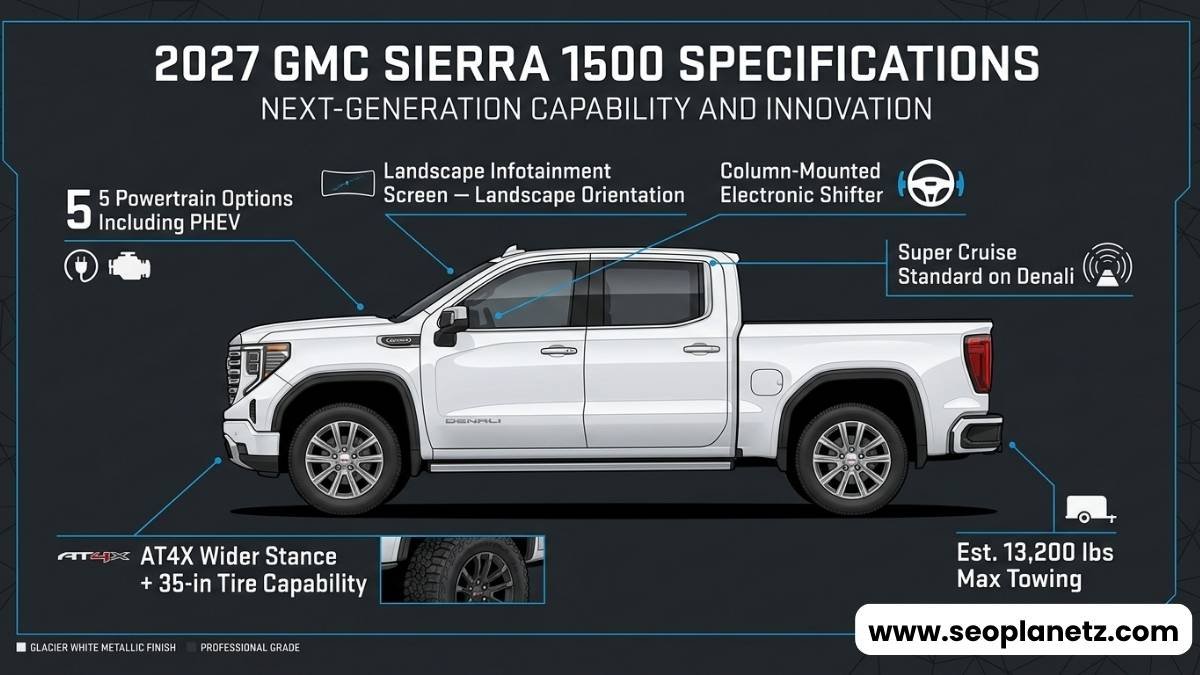
The 2027 GMC Sierra 1500 redesign brings the most significant powertrain overhaul since the current generation launched in 2019. Diesel confirmation came directly from prototype imagery — a green sticker reading “diesel” was spotted on a test mule’s steering wheel by Car and Driver photographers, confirming the 3.0L Duramax inline-six carries forward. When evaluating 2027 GMC Sierra engine options, buyers will have five distinct powertrains to choose from — ranging from the efficient 2.7L TurboMax four-cylinder to the expected PHEV system.
| Engine | Type | Est. HP | Est. Torque | Est. 0–60 mph | Transmission | Est. Max Towing |
|---|---|---|---|---|---|---|
| 2.7L TurboMax I4 | Turbo Gas | 310 hp | 430 lb-ft | ~6.5 sec | 8-speed auto | ~9,500 lbs |
| 5.3L V8 EcoTec3 | Gas V8 | 355 hp | 383 lb-ft | ~6.1 sec | 10-speed auto | ~11,000 lbs |
| 6.2L V8 EcoTec3 | Gas V8 | 420+ hp | 460 lb-ft | ~5.4 sec | 10-speed auto | ~13,000+ lbs |
| 3.0L I6 Duramax | Turbodiesel | 305 hp | 495 lb-ft | ~6.8 sec | 10-speed auto | ~13,200 lbs |
| PHEV (Expected – Ford F-150 PowerBoost Competitor) | Plug-In Hybrid | ~400 hp est. | TBD | ~5.8 sec est. | eCVT/Auto | TBD |
All figures are pre-production estimates based on prototype analysis and industry reporting. Official specs not yet confirmed by GMC.
The 10-speed automatic transmission carries forward on V8 and diesel configurations, with expected refinements to torque converter calibration that should translate to smoother towing engagement — an area where the current generation has received mixed feedback under heavy trailer loads.
The 6.2L V8 remains the performance and towing flagship for buyers who prioritize maximum capability over fuel efficiency. Paired with the Max Trailering Package, it’s expected to maintain the Sierra’s competitive position near the top of the half-ton towing charts.
For fuel-conscious buyers, the 3.0L Duramax diesel continues to offer the most compelling combination of towing capability and real-world economy. Based on the outgoing engine’s performance, expect approximately 23 city / 30 highway mpg — figures that hold up exceptionally well under moderate towing loads. Official EPA ratings will be published closer to launch on fueleconomy.gov.
The PHEV Question — GMC’s Answer to the F-150 PowerBoost
The plug-in hybrid development for the 2027 Sierra is perhaps the most strategically significant powertrain news in this entire redesign. GM Authority and multiple industry sources confirm a PHEV powertrain is in development as part of GM’s broader commitment to offer electrified options across its light-duty truck lineup — separate from the battery-electric Sierra EV platform.
The system is expected to pair a turbocharged combustion engine with an electric motor, delivering an estimated 30–50 miles of EV-only range for typical daily commuting. Beyond that range, the combustion engine assumes primary duty seamlessly. This architecture makes particular sense for truck buyers who do the majority of their driving locally but still need full towing capability on weekends or work sites.
Ford’s F-150 PowerBoost — which pairs a V6 with an electric motor — became one of the most popular F-150 configurations almost immediately after launch. GMC has clearly studied that success. The 2027 Sierra PHEV represents a direct competitive answer, potentially with the added advantage of genuine plug-in capability rather than the PowerBoost’s hybrid-only architecture.
For a broader look at what PHEV ownership involves in real-world conditions, our guide on Hybrid Car Problems in 2026 covers the key considerations buyers should evaluate before committing.
Trim Levels — Full Hierarchy and Feature Breakdown
| Trim | Est. Starting Price | Super Cruise | Seating | Key Differentiator |
|---|---|---|---|---|
| Pro | ~$40,000 | No | Cloth | Digital cluster + landscape screen — finally a worthy work truck |
| SLE | ~$46,000 | No | Cloth/Vinyl | Value-focused family trim, most practical entry point |
| SLT | ~$52,000 | Available | Leather | The daily driver sweet spot — leather, tech, available Super Cruise |
| Elevation | ~$54,000 | No | Cloth/Leather | Sport-appearance package, blacked-out trim |
| AT4 | ~$58,000 | Available | Leather | Off-road suspension, skid plates, wider stance |
| AT4X | ~$67,000 | Available | Premium Leather | Maximum off-road hardware, electronic locking diffs |
| Denali | ~$72,000 | Standard | Premium Leather | Luxury flagship — HUD, air ride, Super Cruise standard |
| Denali Ultimate | ~$82,000+ | Standard | Semi-Aniline Leather | Every available feature including massaging seats, night vision |
Best trim for daily family use: SLT — leather seating, available Super Cruise, without the off-road premium of AT4. Best trim for work and towing: Pro or SLE with the 6.2L V8 and Max Trailering Package. Best trim for off-road: AT4X — no compromise on capability hardware. Best trim for technology: Denali — Super Cruise standard, HUD, full driver assist suite.
For context on how GMC structures its Denali luxury tier across full-size vehicles, our 2027 GMC Yukon Denali guide provides useful comparison.
2027 GMC Sierra Denali vs. Base Pro — The Real Difference
The gap between the base Pro and the 2027 GMC Sierra 1500 Denali is the widest it has ever been — and the most justified. As part of the broader 2027 GMC Sierra 1500 redesign, GMC has ensured that the Denali feels like a genuinely different vehicle rather than a cosmetically upgraded base truck.
Prototype imagery of the Denali shows 22-inch wheels, power-running boards, and Bridgestone Alenza tires — a combination that signals this is a luxury truck wearing serious hardware. Inside, expect semi-aniline leather seating surfaces, massaging front seats, a 15-inch head-up display, and Super Cruise as standard equipment — the only hands-free highway driving system in the segment that uses precision LiDAR map data rather than just camera-based lane detection.
The Denali Ultimate goes further with active air suspension, a Bose premium audio system, and what is expected to be the Sierra’s most comprehensive ambient lighting suite. The price premium over Pro is approximately $40,000 — significant, but defensible given the content gap.
See how GMC’s feature hierarchy plays out across its full lineup in our GMC Acadia Expert Guide.
Super Cruise — What It Is and Why It Matters for Sierra Buyers
Super Cruise is not simply adaptive cruise control with lane centering. It is a hands-free highway driving system that uses precision LiDAR-mapped road data, a driver attention camera, and GPS positioning to enable genuine hands-free operation on compatible highways. The distinction matters because many competing systems still require hand contact with the steering wheel — Super Cruise does not.
For the 2027 Sierra, Super Cruise will be available on SLT and above, with the Denali and Denali Ultimate receiving it as standard equipment. The base Pro’s absence of the indicator light bar on its prototype steering wheel — clearly visible in spy shots — confirms this trim will not receive the feature.
The hands-free trailering assist capability, which uses cameras to automate the hitch alignment and backing process, is expected on Denali variants. For a driver managing a boat, RV, or work trailer regularly, this feature alone justifies a significant portion of the Denali’s price premium.
GMC’s Super Cruise network currently covers over 400,000 miles of compatible North American highways per GMC’s official Super Cruise documentation. The 2027 system is expected to expand coverage and improve reliability in construction zones.
Safety Suite & ADAS — Full Feature Breakdown
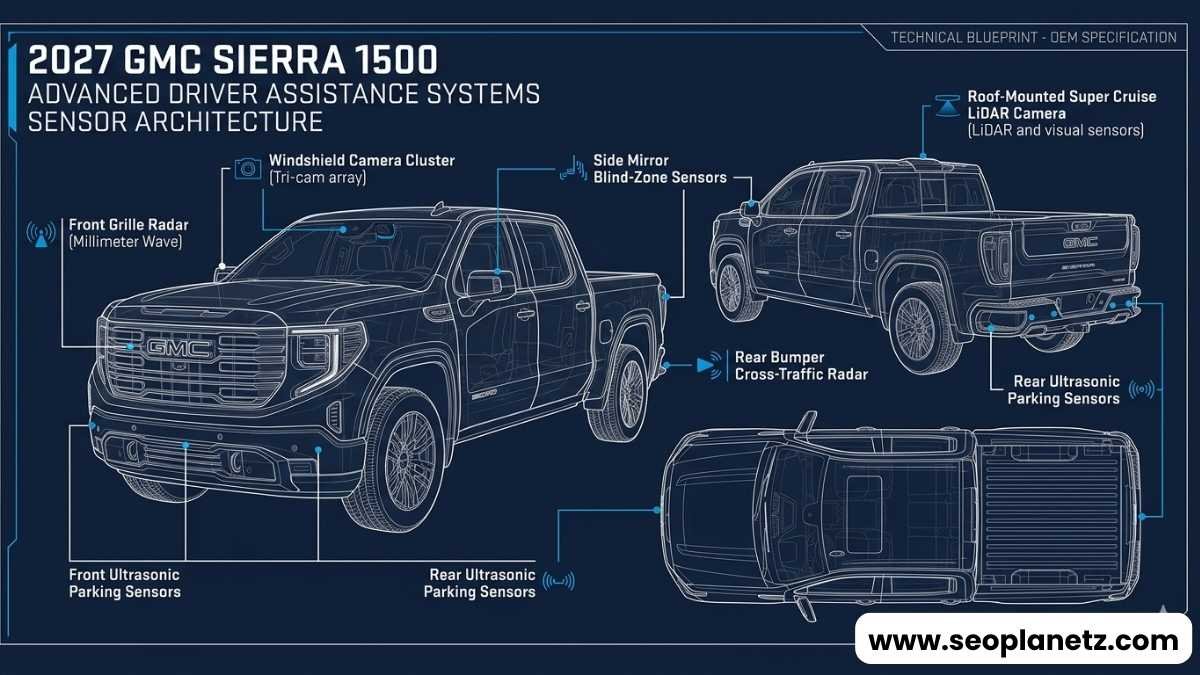
NHTSA and IIHS crash test results will not be available until the truck reaches full production. However, based on the T1-2 platform’s structural improvements and GM’s current ADAS feature roadmap, the expected safety suite is:
Standard across all trims:
- Automatic Emergency Braking with pedestrian and cyclist detection
- Lane Keep Assist with Lane Departure Warning
- Blind-Zone Steering Assist
- Rear Cross-Traffic Alert with Automatic Braking
- Following Distance Indicator
- Forward Collision Alert with haptic seat warning
Available on upper trims:
- Super Cruise with hands-free trailering (SLT and above)
- Surround-view HD camera system with trailer camera integration
- Enhanced Automatic Parking Assist
- Night Vision with pedestrian highlight (Denali Ultimate)
- Trailer Sway Control with predictive load sensing
For current NHTSA crash test protocols and what they measure, the NHTSA Vehicle Safety Ratings database provides full methodology documentation.
Fuel Efficiency — Projected Real-World MPG
| Engine | Est. City | Est. Highway | Est. Combined | Best Use Case |
|---|---|---|---|---|
| 2.7L TurboMax I4 | 18–19 mpg | 22–24 mpg | 20–21 mpg | Daily commuting, light loads |
| 5.3L V8 | 16–17 mpg | 21–23 mpg | 18–20 mpg | Balanced capability and efficiency |
| 6.2L V8 | 14–15 mpg | 20–21 mpg | 17–18 mpg | Maximum towing, performance driving |
| 3.0L Duramax Diesel | 22–23 mpg | 29–30 mpg | 25–26 mpg | High-mileage drivers, long-haul towing |
| PHEV (Expected) | ~40 MPGe EV | ~25 mpg hybrid | TBD | Urban commuters, fleet operators |
The diesel’s real-world advantage becomes most apparent on long highway drives — particularly under light towing loads where the engine operates efficiently in its torque band. Buyers logging 20,000+ miles annually should calculate the diesel’s fuel savings against its price premium over the V8, which typically reaches breakeven within 40,000–50,000 miles depending on fuel prices.
The PHEV option is most compelling for buyers with predictable daily commutes under 40 miles who also need occasional towing capability — a profile that matches a large portion of the American pickup truck market. Federal EV tax credit eligibility for the Sierra PHEV will depend on battery capacity and North American assembly requirements per U.S. Department of Energy guidelines.
Dimensions & Competitive Positioning
| Specification | 2027 GMC Sierra (est.) | Ford F-150 | Ram 1500 | Toyota Tundra |
|---|---|---|---|---|
| Overall Length (Crew/SB) | ~231 in | 231.7 in | 232.9 in | 233.6 in |
| Wheelbase | ~147.4 in | 145.4 in | 144.5 in | 145.7 in |
| Bed Length — Short Box | ~69.9 in | 67.1 in | 67.4 in | 66.7 in |
| Max Towing Capacity | ~13,200 lbs | 13,500 lbs | 12,750 lbs | 12,000 lbs |
| Max Payload Capacity | ~2,200 lbs | 2,235 lbs | 2,300 lbs | 1,940 lbs |
| Ground Clearance (AT4X) | ~9.4 in | 9.4 in (Raptor) | 8.0 in | 10.2 in (TRD Pro) |
| Approach Angle (AT4X) | ~30° | 31° (Raptor) | ~24° | ~29° (TRD Pro) |
The 2027 Sierra’s towing and payload numbers are expected to remain highly competitive against the F-150 and clearly ahead of the Tundra. The dimension story is largely consistent across the segment — where the Sierra differentiates is interior quality, technology suite, and the Denali luxury tier, which has no true equivalent in the F-150 or Tundra lineups.
Off-Road Capability — AT4 and AT4X Analysis
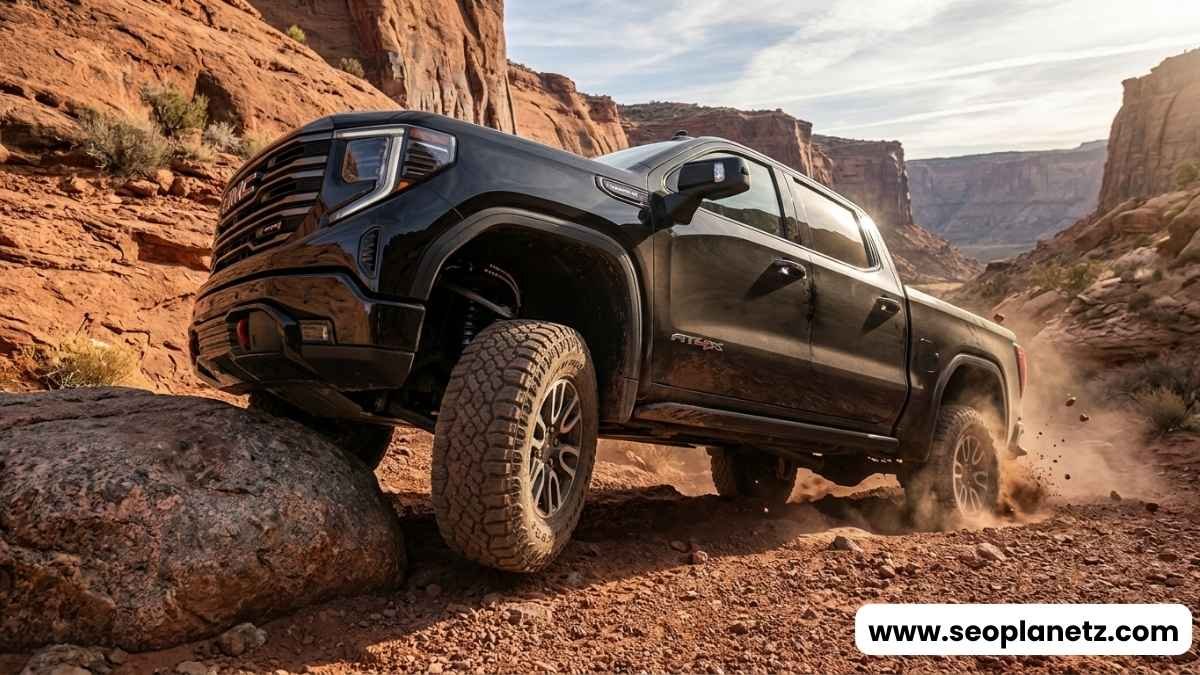
Prototype analysis of AT4X test mules reveals a measurably wider front and rear track than the outgoing model — a change that serves two purposes simultaneously. It improves stability in high-speed desert running conditions while also creating room for significantly larger tires without rubbing interference.
Expected AT4X hardware based on prototype observations:
- Electronic locking front and rear differentials
- Multimatic DSSV spool-valve dampers — the same units used in performance applications
- Full underbody skid plate system
- Approach angle approximately 30° / departure approximately 26° / breakover approximately 22°
- Available 35-inch all-terrain tire fitment
The standard AT4 receives the suspension benefits without the AT4X’s locking differential hardware — positioning it as the trail-capable daily driver, while the AT4X targets buyers who genuinely use their trucks for technical off-road driving.
For context on how GMC approaches electrified performance and capability in its truck lineup, our GMC Hummer EV Pickup Review provides relevant comparison.
Driving Characteristics — What Prototype Analysis Tells Us
Based on engineering analysis of the T1-2 platform updates and observations from prototype testing sessions, several meaningful improvements are expected over the outgoing generation.
Highway refinement: The T1-2 platform incorporates additional structural rigidity specifically targeting NVH — noise, vibration, and harshness — at highway speeds above 65 mph. The outgoing Sierra has drawn consistent criticism for wind and road noise intrusion at interstate speeds, particularly in standard cab configurations. The structural changes observed in prototype builds suggest this has been specifically targeted.
Low-speed maneuverability: The column-mounted shifter and the interior’s reconfigured center stack are expected to contribute to a notably less cluttered driving position — a change that translates to real-world comfort during extended urban driving or tight job-site maneuvering.
Towing stability: Improvements to the trailer monitoring system and expected updates to the StabiliTrak trailer integration suggest more confident towing dynamics, particularly during crosswind conditions — an area where the current Sierra performs adequately but not exceptionally compared to the Ram 1500’s trailer coaching system.
Wait or Buy? — 2026 vs. 2027 Sierra Decision Guide
⚡ Bottom Line: If you need a truck within 90 days, buy the 2026 and negotiate hard. If your timeline is flexible, the 2027 redesign justifies the wait for almost every buyer segment.
Buy the 2026 Sierra now if: You have an immediate operational need — a work truck replacement, a towing requirement that can’t wait. Dealers are already aware the redesign is coming and are motivated to move 2026 inventory. Realistic discounts of $4,000–$7,000 off MSRP are achievable on well-equipped 2026 models through mid-2027.
Wait for the 2027 Sierra if: Interior quality is important to you. You want the PHEV option. You’re considering the AT4X and want the wider stance. You plan to keep the truck for 8–10 years and want the latest platform’s longevity. You want Super Cruise and the full digital interior experience from day one.
The resale value calculation also favors waiting. A 2027 Sierra purchased at launch will not face immediate generational depreciation — the 2026 model faces accelerated depreciation now that the redesign is confirmed. Per Kelley Blue Book’s valuation methodology, outgoing-generation trucks typically depreciate 8–12% faster than normal in the 12 months following a successor reveal.
For buyers still researching the 2027 GMC Sierra release date and whether the wait is worth it — the answer depends entirely on your timeline and priorities, as outlined above. What is certain is that the 2027 GMC Sierra 1500 redesign represents the most compelling reason to pause any current-generation Sierra purchase since the 2022 refresh launched.
Total Cost of Ownership — 5-Year Estimate
| Cost Category | Est. Annual Cost (SLT / 5.3L V8 / 15k miles) |
|---|---|
| Fuel (at $3.50/gallon avg.) | ~$2,750–$3,100 |
| Insurance (national avg. full coverage) | ~$1,900–$2,400 |
| Scheduled Maintenance | ~$800–$1,200 |
| Tire Replacement (amortized / 50k mi) | ~$400–$600 |
| Year 1 Depreciation (est.) | ~$7,000–$9,000 |
| Estimated 5-Year TCO | ~$58,000–$72,000 |
Switching to the 3.0L Duramax diesel reduces the annual fuel cost by approximately $600–$900 at 15,000 miles per year — meaningful but not transformative for most buyers. The PHEV option, once confirmed with EPA ratings, could reduce that fuel line significantly further for buyers with short daily commutes and home charging access.
GMC trucks have historically held strong resale positions — typically retaining 50–55% of original MSRP after three years of ownership, positioning the Sierra competitively against both the F-150 and Ram 1500 in long-term ownership economics.
Pros & Cons — Honest Assessment
| ✅ PROS | ❌ CONS |
|---|---|
| First full redesign since 2019 — genuine generational leap | Official specs and pricing still unconfirmed |
| Physical controls retained — deliberate, buyer-focused decision | 6–12 month wait minimum for most buyers |
| PHEV option expected — finally competes with F-150 PowerBoost | PHEV towing capacity and pricing unconfirmed |
| Column shifter dramatically improves center console utility | Denali Ultimate will likely exceed $85,000 |
| AT4X wider stance improves real off-road capability | NHTSA/IIHS ratings unavailable until production |
| Digital cluster standard even on base Pro trim | MultiPro tailgate largely unchanged |
| Super Cruise with hands-free trailering on upper trims | Sierra EV remains on separate Ultium platform |
| T1-2 platform targets outgoing model’s NVH weaknesses | Compressed launch timeline may mean early production variability |
Is GMC Stopping Truck Production in 2027?
This question surfaces regularly in search data, typically tied to broader concerns about GM’s EV transition and manufacturing restructuring announcements. The answer, based on all available evidence, is unambiguous: no.
A full fifth-generation redesign of the Sierra 1500 — involving a new platform, new interior architecture, new powertrain options, and the engineering investment that entails — represents one of the most capital-intensive commitments a manufacturer can make. Companies do not spend hundreds of millions of dollars redesigning vehicles they plan to discontinue.
GM’s public statements, SEC filings, and manufacturing commitments consistently confirm continued investment in light-duty truck production at Fort Wayne through the foreseeable future. The Sierra remains one of GM’s most profitable vehicle lines — a status that insulates it from the kind of restructuring affecting less profitable segments. Full SEC documentation is available through SEC.gov’s EDGAR database.
Frequently Asked Questions
When is the 2027 GMC Sierra release date?
The 2027 GMC Sierra is expected to be officially revealed in Fall 2026, with customer deliveries starting in early-to-mid 2027. Production is scheduled to begin around January 2027 at GM’s Fort Wayne Assembly plant.
What do the 2027 GMC Sierra interior spy shots reveal?
Recent 2027 GMC Sierra interior spy shots confirm a massive, landscape-oriented touchscreen infotainment display and a fully digital cockpit overhaul. The prototype also reveals a clean column-mounted electronic stalk shifter that replaces the bulky center console gear selector.
Will the 2027 GMC Sierra have physical buttons?
Yes, the 2027 GMC Sierra retains physical buttons for essential controls. Spy photos confirm a dedicated row of physical rocker switches and HVAC toggle controls located directly below the new landscape screen for easy tactile use.
What engine options are expected for the 2027 GMC Sierra redesign?
The next-gen truck will introduce GM’s highly anticipated Gen 6 Small Block V8 engine family alongside the popular 3.0L Duramax Turbo-Diesel. Standard carryover gas V8 and efficient I4 options will also be available across various trims.
Is there a hybrid version coming for the 2027 GMC truck lineup?
Yes, a plug-in hybrid (PHEV) powertrain is currently in development for the 2027 Sierra 1500 lineup. This configuration is engineered to deliver an estimated 30–50 miles of EV-only range and compete directly with Ford’s F-150 PowerBoost.
Will the 2027 GMC Sierra feature Super Cruise?
Yes, GM’s signature Super Cruise hands-free driving assistance will be standard on high-tier trims. It will come standard on the Denali and Denali Ultimate, and remain optional on SLT and AT4 trims.
How does the 2027 GMC Sierra Denali differ from the base Pro trim?
The luxury Denali trim features 22-inch wheels, semi-aniline leather, and standard Super Cruise, while the base Pro trim serves as a work truck. However, both trims will now share the upgraded digital cockpit and landscape display layout.
Is GMC going out of business or stopping truck production in 2027?
No, GMC is not stopping truck production or going out of business. The massive capital investment into this fifth-generation T1-2 platform redesign proves that the Sierra remains GM’s core profitable lineup well into the future.
Final Verdict
The 2027 GMC Sierra 1500 redesign is not incremental. Based on everything prototype analysis, engineering observation, and competitive context can tell us ahead of the official reveal, this is a truck that has been built with a clear understanding of what the segment’s buyers actually want — and what the outgoing generation failed to deliver.
The physical controls decision alone sets the 2027 Sierra apart in a market trending toward touchscreen minimalism. The column shifter and expanded console storage address a real ownership frustration. The digital cluster across all trims levels the playing field for entry-level buyers. And the expected PHEV option finally gives Sierra a credible answer to the F-150 PowerBoost’s market success.
The Denali continues to be the Sierra’s most compelling argument — a luxury-grade truck with genuine capability credentials that neither the F-150 Platinum nor the Ram 1500 Limited fully matches in terms of the complete driver assist and off-road package combination.
If your current truck situation allows any flexibility on timing, waiting for the 2027 Sierra is the right call. If you buy the 2026 today, negotiate aggressively — dealer discounts will only grow as the redesign approaches. Either way, the Sierra is back at the top of the full-size truck conversation in America.