

Alternator failure is one of the most disruptive electrical problems a driver can face — and it often strikes with very little warning. The alternator is the heart of your car’s charging system, responsible for powering every electrical component while the engine runs and keeping the battery topped up at the same time. When it starts to fail, the entire vehicle is at risk. From dimming headlights to a completely dead car on the highway, the consequences of ignoring alternator failure are serious. In this guide, you’ll learn every major cause of alternator failure in 2026, the warning signs to watch for, how much repairs cost, and exactly what you can do to prevent it from happening in the first place.
How an Alternator Works — And Why It Fails
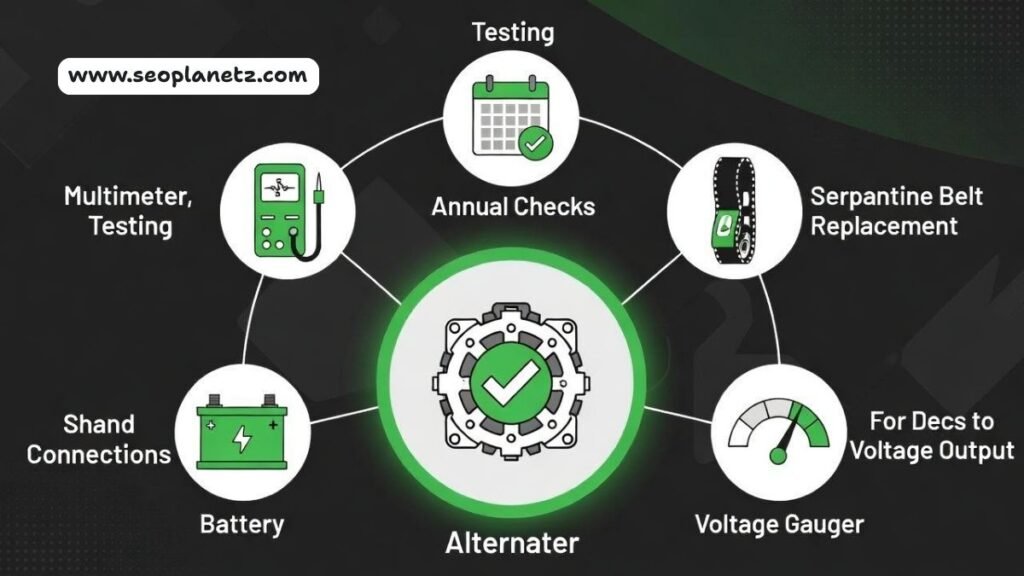
Before understanding alternator failure, it helps to understand what the alternator actually does. It’s an AC generator driven by the engine’s serpentine belt. It converts mechanical energy into electrical energy, outputting 13.5V to 14.7V DC after rectification through internal diodes.
Inside every alternator are three main components that wear out over time: the rotor, stator, and rectifier diodes. Any one of these failing causes the entire unit to stop functioning correctly.
The Role of the Voltage Regulator
The voltage regulator — built into most modern alternators — controls how much current the alternator produces based on electrical demand. A faulty regulator can cause the alternator to overcharge (damaging the battery) or undercharge (starving the electrical system). Both conditions accelerate alternator failure significantly.
According to MIT OpenCourseWare’s automotive engineering modules, alternators in modern vehicles manage increasingly complex loads from advanced driver assistance systems, making regulator reliability more critical than ever.

Top Causes of Alternator Failure in 2026
1. Worn Carbon Brushes
Carbon brushes transfer electrical current to the rotating slip rings on the rotor. These brushes wear down gradually over tens of thousands of miles. Once worn below a critical length, they lose consistent contact and output becomes erratic.
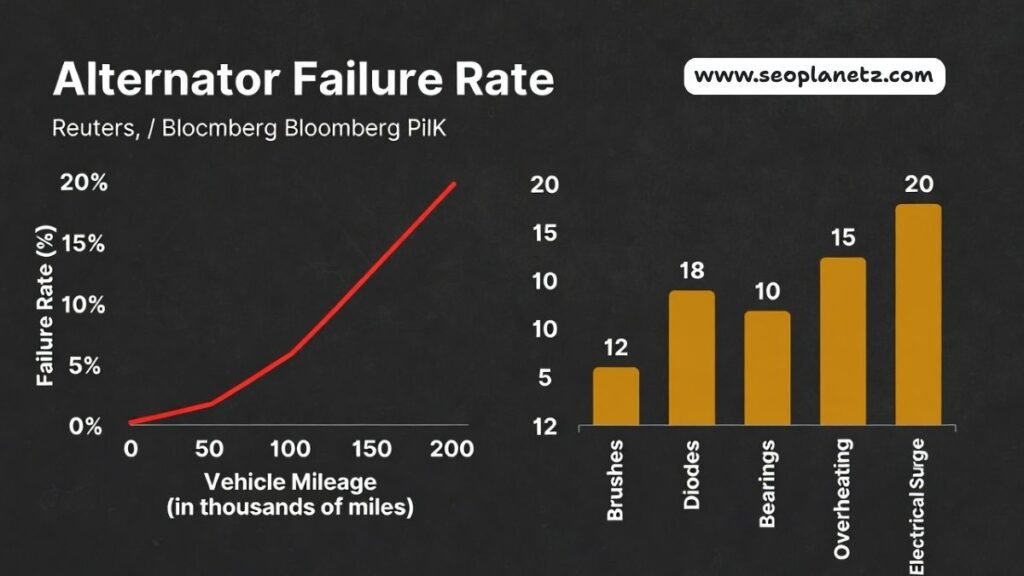
This is the single most common cause of alternator failure in high-mileage vehicles. Many alternators can be repaired simply by replacing brushes — a $15 part — rather than buying a whole new unit.
2. Failed Rectifier Diodes
The rectifier converts AC output from the stator into DC power your car can use. It contains six diodes — three positive, three negative. When even one diode fails, the alternator’s output drops significantly and it may start drawing current backward from the battery when the car is off.
This is a known issue in 2026 Chevy alternator failure reports on forums, where diode failure on certain GM charging systems causes overnight battery drain alongside charging system warnings.
Also Read: Car Fuel Pump Price and Maintenance in 2026
3. Overheating
Heat is the primary enemy of alternator longevity. The alternator sits in the engine bay where temperatures regularly exceed 200°F. Over time, heat degrades insulation on stator windings, warps bearing races, and cracks solder joints on the rectifier board.
Vehicles that idle heavily in traffic — rideshare cars, delivery vehicles, taxis — experience accelerated alternator failure due to sustained high thermal load with minimal airflow.
4. Bearing Failure
Alternators spin at 2–3x the engine RPM through the belt ratio. At highway speeds, the rotor bearing may spin at 15,000–18,000 RPM. These bearings wear out naturally, but contamination from oil leaks dramatically shortens their life.
A grinding or whining noise from the alternator that changes with engine RPM almost always indicates bearing failure. Ignoring it leads to complete alternator failure when the bearing seizes.
5. Overloading the Electrical System
Every aftermarket accessory you add — high-powered audio amplifiers, light bars, auxiliary lighting — draws current the alternator must produce. Exceeding the alternator’s rated output capacity causes it to run at 100% load constantly, drastically reducing lifespan.
The Society of Automotive Engineers (SAE) recommends keeping total electrical load below 80% of alternator rated output for normal operating life expectancy.
Also Read: How to Negotiate a Car Price in 2026
6. Belt and Pulley Issues
The alternator only charges when the serpentine belt turns its pulley. A worn, cracked, or slipping belt reduces alternator output. A seized alternator pulley can snap the belt entirely, immediately disabling charging, power steering, and cooling simultaneously.
Overrunning alternator pulleys (OAPs) — common on modern vehicles — add a one-way clutch to reduce vibration. When this clutch fails, it creates a characteristic chattering noise and inconsistent charging.
7. Voltage Spikes and Jump-Starting Errors
Connecting jumper cables incorrectly (reverse polarity) sends a voltage spike directly through the alternator’s diode bridge. This instantly destroys the rectifier in most cases. Even correct jump-starting on modern vehicles can damage sensitive electronics — always use a proper jump starter, not another running vehicle.
According to AAA, incorrect jump-starting is responsible for thousands of avoidable electrical component failures annually, including alternator failures.
| Failure Cause | Affected Component | Typical Mileage of Failure | Repair vs Replace |
|---|---|---|---|
| Worn brushes | Brush assembly | 80,000–120,000 mi | Repair ($20–50) |
| Diode failure | Rectifier board | 70,000–100,000 mi | Repair or replace |
| Bearing wear | Rotor bearing | 100,000–150,000 mi | Replace ($200–400) |
| Overheating | Stator windings | Variable | Replace |
| Voltage spike | Rectifier diodes | Any mileage | Replace |
| Belt/pulley | OAP / serpentine | 60,000–90,000 mi | Repair ($50–150) |
Table 1: Common alternator failure causes, mileage ranges, and repair options
Alternator Failure Symptoms You Shouldn’t Ignore
Catching alternator failure symptoms early can save you from being stranded. Here’s what to watch for:
- Battery warning light illuminated (often looks like a battery, not an alternator — but it monitors the charging system)
- Dimming or flickering headlights, especially at idle
- Electrical accessories behaving erratically — windows moving slowly, radio cutting out, seat heaters cycling
- Burning rubber or electrical smell from the engine bay
- Grinding or whining noise that changes with RPM
- Dead battery despite recent replacement — a classic sign of alternator failure
- Voltage reading below 13V with engine running
Do Alternators Fail Suddenly?
Yes — and this surprises many drivers. While gradual wear is most common, diode failure and bearing seizure can happen without warning. Many alternator failures on Reddit threads (especially alternator failure 2026 discussions) describe cars that ran perfectly one day and died the next.
This is why regular charging system tests — available free at most auto parts stores — are so valuable.
Alternator Failure Cost: What to Expect in 2026
Alternator failure cost depends on whether you repair or replace, and whether you go OEM or aftermarket.
Remanufactured alternators are a popular middle ground — rebuilt OEM cores with new brushes, bearings, and diodes at roughly 40–60% of new OEM price.
| Vehicle Type | Remanufactured | New OEM | Labor (1–2 hrs) | Total Estimate |
|---|---|---|---|---|
| Economy sedan | $80–$130 | $200–$350 | $80–$160 | $160–$510 |
| Mid-size SUV | $120–$200 | $280–$450 | $100–$180 | $220–$630 |
| Truck / V8 | $150–$250 | $300–$600 | $120–$200 | $270–$800 |
| Luxury / European | $200–$400 | $500–$1,000+ | $150–$300 | $350–$1,300 |
Table 2: Alternator failure cost estimates by vehicle type in 2026 (USD)
RepairPal’s alternator cost estimator provides zip-code-specific pricing to compare local shop rates against these averages.
Can a new alternator fail? Unfortunately, yes. Low-quality remanufactured units have higher early failure rates. A new alternator failed within months is almost always a quality issue — always buy from reputable suppliers with at least a 1-year warranty.
Also Read: 2026 Ford Escape Review, Price, and Specs
Alternator Failure Voltage — What the Numbers Tell You
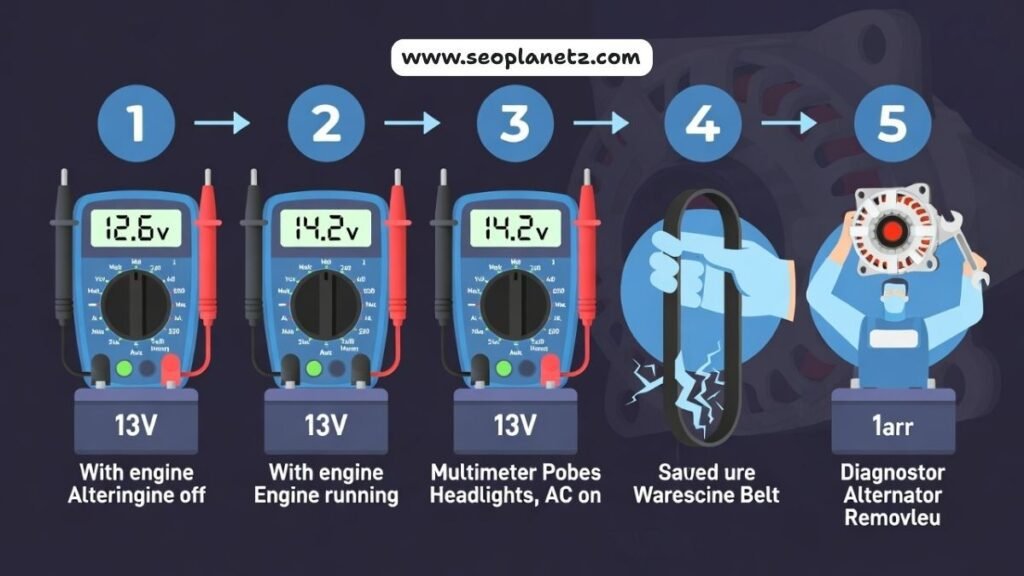
Voltage readings are the fastest diagnostic tool for alternator failure. Here’s how to interpret them:
With engine off: Battery should read 12.4V–12.7V (fully charged). Below 12V indicates a depleted or failing battery.
With engine running at idle: Should read 13.5V–14.7V. This range confirms the alternator is charging.
With engine running + all accessories on: Voltage should stay above 13.2V. A significant drop under load suggests the alternator is undersized for the electrical demand or beginning to fail.
Above 15V: Voltage regulator failure causing overcharge — will boil the battery and damage electronics.
A $10 multimeter from any hardware store gives you these readings in under 2 minutes. NHTSA’s vehicle safety resources recommend periodic electrical system checks as part of routine vehicle maintenance.
Also Read: 2026 Toyota Prius Review, Price, and Specs
Can an Alternator Last 200,000 Miles?
Yes — some do. Alternator last 200,000 miles is achievable with the right conditions: moderate electrical loads, clean engine bay, no oil contamination, and quality original components. Japanese vehicles like Toyota and Honda are frequently cited in long-life case studies.
However, the 2026 Toyota alternator failure reports on forums show that even reliable manufacturers aren’t immune — particularly in hybrid models where the charging system architecture is more complex and thermal loads are higher.
Average alternator lifespan across all makes is 80,000 to 150,000 miles or roughly 7 to 10 years.
Why Is My Car Killing Alternators?
If you’re on your second or third alternator in a short period, the alternator itself isn’t the root cause — something else is destroying it. Common reasons:
- Chronic overloading from aftermarket audio or lighting systems exceeding rated output
- Oil leaks contaminating the alternator housing and bearing
- Faulty battery forcing the alternator to work at maximum capacity constantly (a dead cell in the battery acts like a permanent load)
- Wiring issues causing voltage spikes or ground faults
- Cheap remanufactured units with inadequate quality control
Fix the underlying issue first, or the replacement will fail just as quickly.
Key Takeaways
- Alternator failure is most commonly caused by worn brushes, failed diodes, bearing wear, or overloading — not random chance
- Alternator failure symptoms include dimming lights, battery warning light, electrical glitches, and voltage below 13V while running
- Most alternators last 80,000–150,000 miles; some reach 200,000 with proper maintenance
- Alternator failure cost ranges from $160 to $1,300 depending on vehicle and parts quality
- A new alternator failing quickly almost always points to a quality issue or underlying electrical problem
- Always test charging system voltage before assuming the battery is at fault
- Keeping electrical load below 80% of rated output significantly extends alternator life
Frequently Asked Questions
Q: How many years before an alternator goes bad?
A: Most alternators last 7 to 10 years under normal use. High electrical loads, extreme heat, oil contamination, and poor-quality remanufactured units can shorten this to 3–5 years.
Q: What is the most common cause of alternator failure?
A: Worn carbon brushes are the most common cause in high-mileage vehicles, followed by failed rectifier diodes. Both are gradual wear items that can often be repaired rather than requiring full replacement.
Q: How much does it cost to fix an alternator failure?
A: Alternator failure repair costs range from $160 for a budget economy car to over $1,300 for a European luxury vehicle. Labor runs $80–$300 depending on accessibility, with parts adding $80–$600.
Q: How does a car act when the alternator is going out?
A: You’ll notice flickering or dimming headlights, slow-moving power windows, erratic dashboard behavior, a battery warning light, and eventually a completely dead car. Voltage readings below 13V with the engine running confirm the issue.
Q: Why is my car killing alternators?
A: Repeated alternator failure usually points to chronic overloading from aftermarket electronics, a bad battery with a dead cell forcing constant max output, oil contamination, or persistent wiring faults. Fix the root cause before replacing the alternator again.
Q: What is the average lifespan of a car alternator?
A: The average lifespan is 80,000 to 150,000 miles or 7–10 years. Well-maintained vehicles on reliable brands sometimes reach 200,000 miles. Rideshare and commercial vehicles often see failure before 80,000 miles due to high idle hours.
Q: Do alternators fail suddenly?
A: Yes — diode failure and bearing seizure can cause sudden alternator failure with no prior warning. However, most failures develop gradually. Regular voltage testing catches the early signs before you’re stranded.
Also Read: 2026 Kia Sorento Review, Price, and Specs
Conclusion
Alternator failure doesn’t have to catch you off guard. The causes are well understood, the symptoms are detectable early, and the fixes — while sometimes costly — are straightforward when you act before complete failure. Whether you’re dealing with a new alternator that failed prematurely, a 2026 Toyota or Chevy showing charging issues, or a high-mileage vehicle approaching the danger zone, the same principles apply: test the voltage regularly, inspect the belt system, avoid overloading the electrical system, and use quality parts when replacing components.
The alternator is one of the hardest-working parts on any vehicle. Treat it well — keep loads reasonable, fix oil leaks promptly, and get the charging system tested annually — and alternator failure becomes a rare event rather than a recurring nightmare. A $10 multimeter and 5 minutes of attention twice a year is all it takes to stay ahead of this problem.