
Introduction
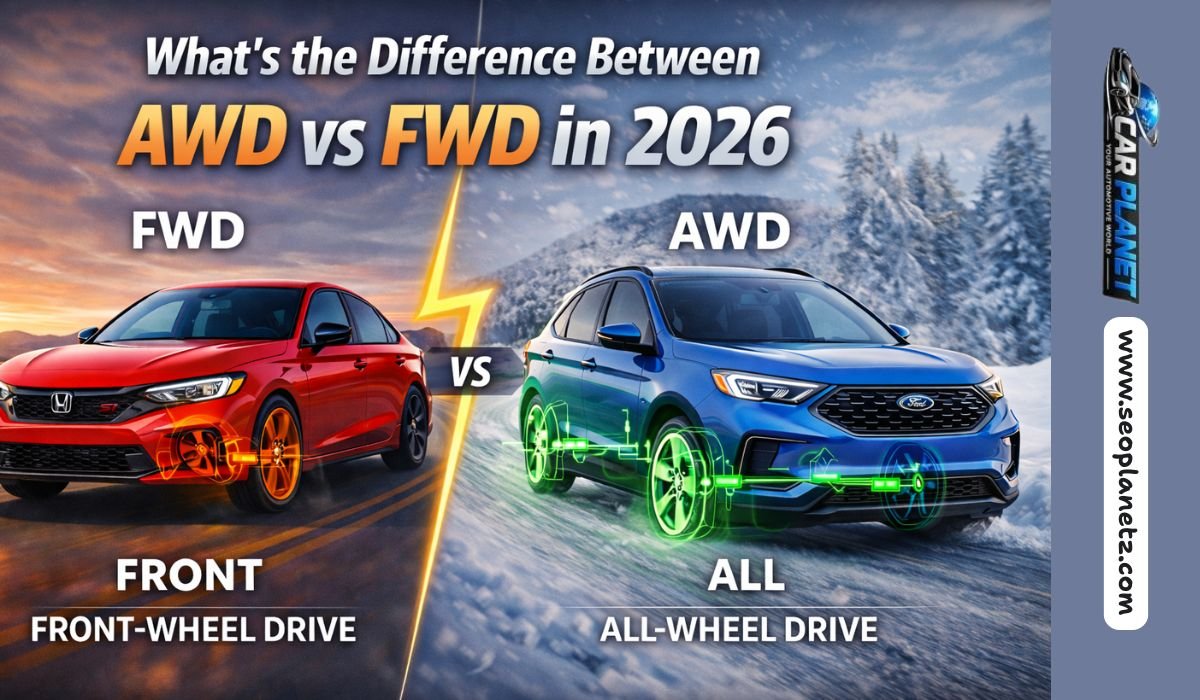
If you’re shopping for a new car in 2026, you’ve probably encountered the terms AWD vs FWD and wondered which one is right for you. Understanding the difference between all-wheel drive and front-wheel drive can save you thousands of dollars and ensure you get the perfect vehicle for your needs. This comprehensive guide breaks down everything you need to know about AWD and FWD systems, helping you make an informed decision.
What’s the Difference Between AWD and FWD?
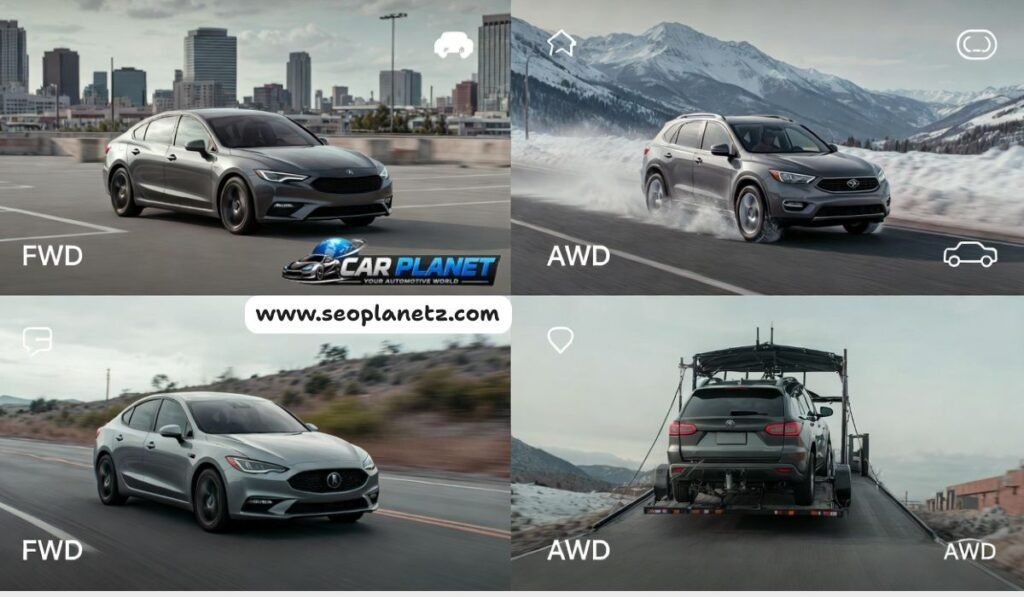
Let’s start with the fundamentals. The difference between AWD and FWD boils down to which wheels receive power from the engine:
Front-Wheel Drive (FWD):
- Engine power goes only to the front wheels
- Front wheels both steer AND propel the vehicle
- Rear wheels simply follow along
- Simpler, lighter system
All-Wheel Drive (AWD):
- Engine power can go to all four wheels
- System automatically adjusts power distribution
- Both front and rear wheels provide traction
- More complex, heavier system
Think of it this way: FWD is like a person pulling a wagon – all the pulling power comes from the front. AWD is like four people pushing a car – everyone contributes when needed.
How Do AWD vs FWD Systems Actually Work?
Understanding the mechanics helps you appreciate the differences.
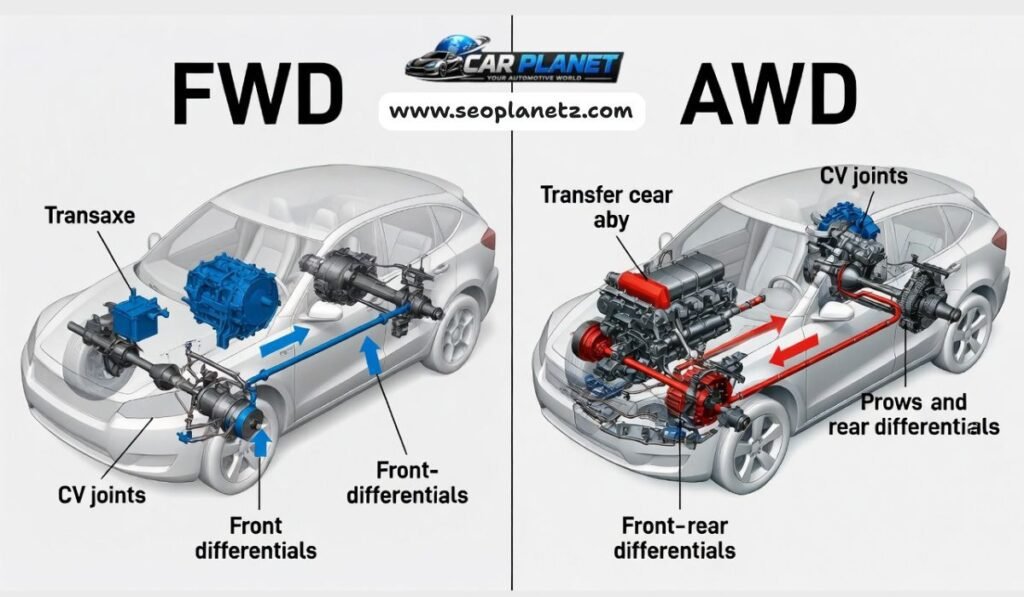
Front-Wheel Drive System
Components:
- Transverse-mounted engine (sideways)
- Transaxle (combines transmission and differential)
- Two front axle shafts (CV axles)
- No driveshaft to rear wheels
How it works:
- Engine produces power
- Transmission sends power to front differential
- Front differential splits power between left and right wheels
- Front wheels pull the car forward
Real-world feel: In normal driving, FWD feels light and nimble. The weight of the engine over the drive wheels provides decent traction in most conditions. However, if you’ve ever felt the front wheels spinning when accelerating hard or climbing a slippery hill, that’s FWD showing its limitations.
Also Read: 2026 Honda Civic Si Performance, Specs, and Features
All-Wheel Drive System
Components:
- Engine (can be mounted transverse or longitudinal)
- Transmission
- Transfer case or center differential
- Front differential
- Rear differential
- Driveshaft connecting front to rear
How it works:
- Engine produces power
- Transmission sends power to transfer case
- Transfer case distributes power between front and rear
- Each differential splits power to individual wheels
- System constantly monitors wheel slip
- Power automatically shifts to wheels with best traction
Real-world feel: AWD typically operates in FWD mode during normal cruising to save fuel. When sensors detect slip, power instantly shifts to the rear wheels. Most drivers never notice this happening – the car just feels more confident and planted in all conditions.
According to engineering data from SAE International, modern AWD systems can redistribute power in milliseconds, making them incredibly responsive to changing road conditions.
AWD vs FWD: Key Differences That Matter
Let’s break down the practical differences you’ll actually notice.
Performance Characteristics
| Aspect | FWD | AWD |
|---|---|---|
| Traction in Snow/Rain | Good | Excellent |
| Acceleration Grip | Moderate | Superior |
| Cornering Ability | Good | Better |
| Hill Climbing | Decent | Excellent |
| Off-Road Capability | Limited | Moderate to Good |
| Fuel Economy | Better | 1-2 mpg worse |
Cost Comparison
Initial Purchase Price:
- FWD: Base price
- AWD: Typically $1,500-$3,000 more
Fuel Costs (Annual estimate for 15,000 miles):
- FWD: Lower (baseline)
- AWD: $150-$300 more per year
Maintenance Costs:
- FWD: Lower (fewer components)
- AWD: Higher (more fluids, more parts)
Insurance:
- FWD: Lower
- AWD: Slightly higher (5-10% more)
According to Consumer Reports testing, the total cost of ownership over 5 years for AWD is approximately $2,000-$4,000 higher than comparable FWD vehicles.
Also Read: How to Used Toyota RAV4 Complete Buyer’s Guide 2026
When Should You Choose FWD?
Front-wheel drive isn’t just the budget option – it’s genuinely the better choice for many drivers.
FWD is Perfect If You:
Live in mild climates: If you rarely see snow or ice, FWD handles rain and normal conditions just fine. Southern states, coastal regions, and moderate climates don’t demand AWD.
Prioritize fuel economy: That 1-2 mpg difference adds up. Over 5 years and 75,000 miles, you’ll save 150-300 gallons of gas with FWD.
Want lower costs: Between purchase price, fuel, and maintenance, FWD saves you $3,000-$5,000 over the vehicle’s life.
Mostly drive on paved roads: FWD excels on highways, city streets, and normal roads. It’s only on slippery surfaces or dirt that you notice limitations.
Drive a sedan or small car: Many sporty sedans and compact cars are FWD-only, and they handle beautifully. Think Honda Civic, Toyota Camry, or Mazda3 – all excellent FWD vehicles.
Real Owner Perspective
“I’ve driven FWD cars in Chicago for 15 years. Good winter tires matter way more than AWD. I’ve never been stuck, and I love the better gas mileage.” – Actual owner testimonial from automotive forums
When Should You Choose AWD?
All-wheel drive provides genuine benefits in specific situations – here’s when it’s worth the investment.
AWD is Essential If You:
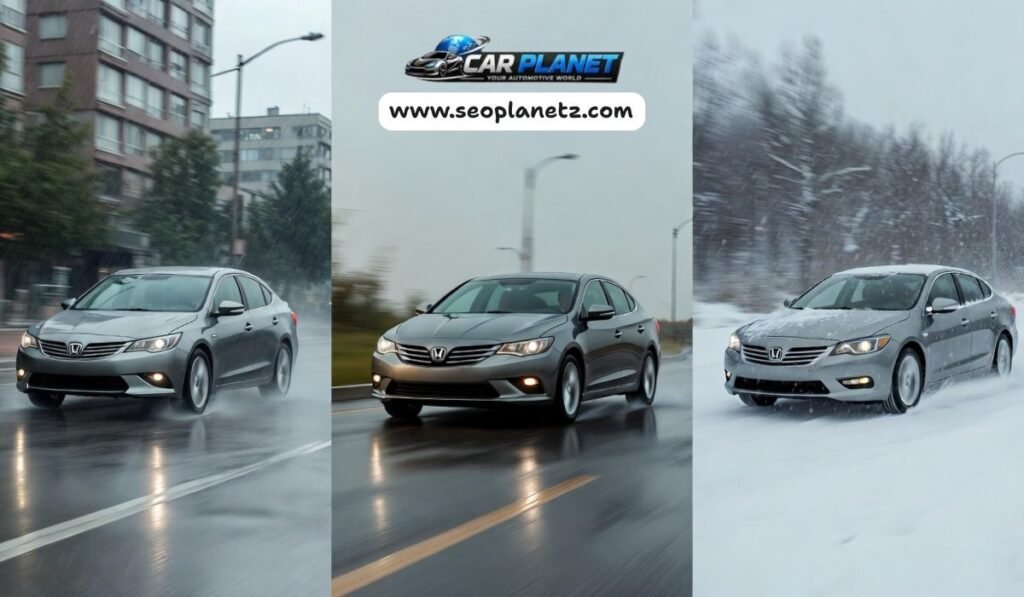
Experience regular snow and ice: If you see snow more than a few times per year, AWD provides peace of mind and genuine safety benefits. Mountains, northern states, and regions with harsh winters benefit from AWD.
Drive on unpaved roads regularly: Dirt roads, gravel driveways, and muddy conditions are where AWD shines. The extra traction helps maintain control on loose surfaces.
Live in hilly or mountainous terrain: Climbing steep hills on slippery surfaces is where AWD proves its worth. That power to all four wheels makes a real difference.
Tow trailers or boats: The extra traction helps when launching boats or pulling trailers up slippery ramps. According to National Highway Traffic Safety Administration (NHTSA) guidelines, AWD improves towing safety.
Value maximum traction for safety: Some drivers simply feel more confident with AWD, and that psychological benefit has real value.
Own an SUV or crossover: Many modern SUVs are designed with AWD in mind, and the system integrates seamlessly into their capabilities.
Real Owner Perspective
“After getting stuck three times in one winter with my FWD car, I switched to AWD. The difference is night and day. I haven’t worried about weather since.” – Vermont owner feedback
Common Myths About AWD vs FWD
Let’s bust some misconceptions that could cost you money or compromise safety.
Myth 1: “AWD Makes You Invincible in Winter”
Reality: AWD helps you GO in slippery conditions, but it does NOT help you STOP. All vehicles have four-wheel brakes, regardless of drivetrain. According to testing by Car and Driver, AWD vs FWD vehicles with identical tires have virtually the same stopping distances on ice.
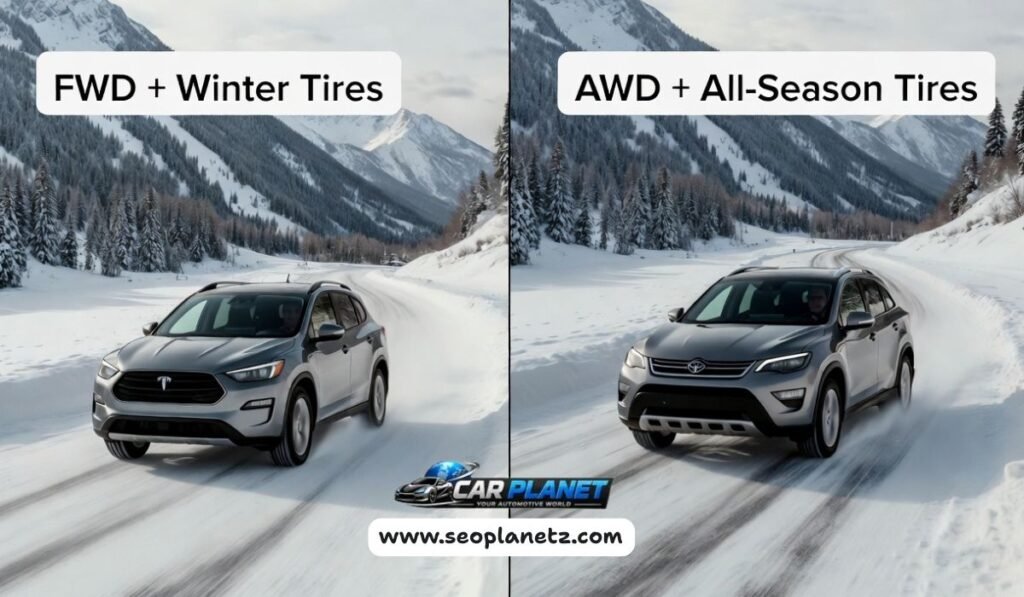
The truth: Winter tires matter far more than AWD for overall winter safety. A FWD car with winter tires will outperform an AWD vehicle with all-season tires in snow.
Myth 2: “FWD is Terrible in Snow”
Reality: FWD actually has an advantage – the engine weight sits directly over the drive wheels, providing natural traction. FWD vehicles with proper winter tires handle snow very well.
Myth 3: “AWD Kills Your Gas Mileage”
Reality: Modern AWD systems disconnect when not needed, minimizing fuel economy impact. The typical penalty is just 1-2 mpg, not the 5-10 mpg some people believe.
Myth 4: “AWD Requires Expensive Maintenance”
Reality: AWD does have more components, but modern systems are reliable. Expect to pay an extra $200-400 over the vehicle’s life for additional fluid changes. Not cheap, but not outrageous either.
Myth 5: “You Need AWD for Light Off-Roading”
Reality: Most AWD systems are designed for on-road traction, not serious off-roading. If you want real trail capability, you need 4WD (four-wheel drive) with low-range gearing, which is different from AWD.
AWD vs FWD: Fuel Economy Impact in 2026
Let’s get specific about the fuel economy difference with real-world examples.
Actual MPG Comparisons (2026 Models)
| Vehicle | FWD MPG | AWD MPG | Annual Fuel Cost Difference* |
|---|---|---|---|
| Honda CR-V | 30 combined | 28 combined | $167 more for AWD |
| Toyota RAV4 | 31 combined | 29 combined | $181 more for AWD |
| Mazda CX-5 | 28 combined | 26 combined | $190 more for AWD |
| Subaru Outback | N/A (AWD only) | 29 combined | N/A |
| Ford Escape | 30 combined | 28 combined | $167 more for AWD |
*Based on 15,000 miles annually at $3.50/gallon
The real cost: Over 5 years, AWD typically costs you $835-$950 extra in fuel alone. Add the initial purchase premium of $2,000-$3,000, and you’re looking at $3,000-$4,000 total additional cost.
When it’s worth it: If AWD prevents even one accident or allows you to get to work during bad weather, it’s paid for itself. Safety and peace of mind have real value.
According to data from FuelEconomy.gov, the AWD fuel penalty has decreased significantly over the past decade as systems have become smarter about disconnecting when not needed.
How Modern AWD Systems Have Evolved
AWD technology in 2026 is light-years ahead of systems from even 10 years ago.
Latest AWD Innovations
Predictive AWD: Modern systems don’t just react to slip – they predict it. Using data from windshield wipers, outside temperature sensors, and even cameras reading the road surface, systems engage AWD before you start to slip.
Disconnect Technology: When cruising on dry pavement, the rear axle physically disconnects to save fuel. It reconnects in milliseconds when needed, so you never notice the transition.
Torque Vectoring: Advanced systems can send power to individual wheels, not just front and rear axles. This improves cornering and handling dramatically.
Integration with Stability Control: AWD systems now work seamlessly with electronic stability control, traction control, and even adaptive suspension for optimal performance.
Brand-Specific Systems
Subaru Symmetrical AWD:
- Always sends power to all four wheels
- Known for excellent balance and capability
- Slightly worse fuel economy due to constant engagement
Honda Real Time AWD:
- Primarily FWD, engages rear only when needed
- Excellent fuel economy
- Simple, reliable system
Audi Quattro:
- Performance-oriented with sophisticated torque vectoring
- Available with sport differential for track capability
- Premium pricing but excellent performance
Toyota AWD-i (Hybrid Systems):
- Uses electric motor for rear wheels
- No mechanical connection needed
- Smooth, instant response

AWD: vs FWD Which Lasts Longer?
Reliability and longevity matter when you’re spending thousands extra for AWD.
Reliability Comparison
FWD Advantages:
- Fewer components means less to break
- Simpler design is easier and cheaper to fix
- Well-proven technology with decades of refinement
- Lower fluid maintenance requirements
AWD Considerations:
- More components increase potential failure points
- Transfer case and rear differential require fluid changes
- More expensive repairs when problems occur
- Modern systems are quite reliable but more complex
According to J.D. Power reliability studies, modern AWD systems have failure rates only marginally higher than FWD – typically less than 1% difference over the first 5 years.
Maintenance Requirements
FWD Maintenance:
- Regular oil changes
- Transmission fluid (60,000-100,000 miles)
- Front differential built into transaxle
- Basic brake and tire maintenance
AWD Maintenance:
- Everything FWD requires, PLUS:
- Transfer case fluid (30,000-60,000 miles)
- Rear differential fluid (30,000-60,000 miles)
- More frequent tire rotations (AWD wears tires unevenly)
- Potential coupling or clutch pack service
Extra cost over 100,000 miles: Approximately $500-800 for additional AWD maintenance.
Real-World Scenarios: FWD vs AWD
Let’s look at specific situations to help you decide.
Scenario 1: Daily Commute in Rain
Your situation: 30-mile highway commute, frequent rain, no snow
FWD performance: Excellent. Modern traction control handles rain beautifully. You’ll never notice any limitation.
AWD benefit: Minimal. Rain isn’t challenging enough to justify AWD.
Recommendation: Save money with FWD.
Scenario 2: Mountain Living with Steep Driveway
Your situation: Live on steep hill, 4-6 snow events per winter
FWD performance: Risky. Steep + snow + FWD = potential for getting stuck.
AWD benefit: Significant. Power to all four wheels makes steep snowy climbs much safer.
Recommendation: AWD is worth the investment here.
Scenario 3: Weekend Camping on Forest Roads
Your situation: Mostly highway, occasional gravel forest roads
FWD performance: Adequate on maintained gravel, struggles on loose or rutted surfaces.
AWD benefit: Noticeable improvement in confidence and capability on unpaved roads.
Recommendation: AWD if you camp frequently; FWD okay for occasional trips.
Scenario 4: Urban Driver, Flat Terrain
Your situation: City driving, flat roads, occasional snow
FWD performance: Perfect for this use case. Winter tires for snow days.
AWD benefit: Marginal. Won’t utilize the capability often enough to justify cost.
Recommendation: FWD is the smart choice.
Scenario 5: Towing Small Boat
Your situation: Tow 2,000-pound boat to lake several times per summer
FWD performance: Can tow, but launching on slippery ramps is challenging.
AWD benefit: Significant. Extra traction prevents wheels spinning on wet boat ramps.
Recommendation: AWD provides real practical benefit for towing.
The Truth About AWD and Winter Driving
This deserves special attention because it’s the #1 reason people buy AWD.
What AWD Actually Does in Winter
AWD helps you:
- Start moving on slippery surfaces
- Climb hills without wheels spinning
- Maintain momentum through snow
- Feel more confident in bad weather
AWD does NOT help you:
- Stop shorter (braking is identical)
- Corner better (limited benefit)
- Drive faster safely (you still need to slow down)
- Ignore winter tires (tires matter more)
The Tire Factor
Here’s a revelation from Tire Rack testing that might surprise you:
Stopping distance on ice from 40 mph:
- FWD with winter tires: 168 feet
- AWD with all-season tires: 212 feet
That’s right – FWD with proper tires stops 44 feet shorter!
The Best Winter Combination
According to automotive safety experts:
- Best: AWD + winter tires = maximum capability
- Great: FWD + winter tires = excellent performance, saves money
- Good: AWD + all-season tires = better than FWD + all-season
- Risky: FWD + worn all-seasons = minimal winter capability
Bottom line: If you can only afford one upgrade, choose winter tires over AWD. If you can afford both, you’ll have exceptional winter capability.
AWD vs FWD: Impact on Vehicle Dynamics
Beyond traction, the drivetrain affects how your car handles.
Handling Characteristics
FWD Handling:
- Understeer tendency (front pushes wide in corners)
- Lighter feel due to less weight
- Front-heavy weight distribution
- Less engaging for enthusiast driving
- More predictable for average drivers
AWD Handling:
- More neutral handling balance
- Better weight distribution
- Can accelerate harder out of corners
- More confidence-inspiring
- Slightly heavier feel
For daily drivers: The handling differences are minimal. Most people won’t notice.
For enthusiasts: AWD provides more engaging dynamics, especially in sporty vehicles like the Subaru WRX or Audi S4.
Performance Application
In performance cars, AWD dominates:
- Faster acceleration (less wheel spin)
- Better track times in most conditions
- More forgiving at the limit
- Examples: Porsche 911 Turbo, Nissan GT-R, Audi RS models
However, purists still prefer rear-wheel drive for ultimate engagement, showing that AWD isn’t always “better” – it depends on your priorities.
Making Your Decision: A Simple Framework
Still not sure? Use this decision tree:
Step 1: Assess Your Climate
Minimal winter weather (less than 5 snow days/year): → FWD is probably sufficient
Moderate winter weather (5-20 snow days/year): → Consider AWD, especially with hills
Harsh winter weather (20+ snow days/year or mountain living): → AWD highly recommended
Step 2: Evaluate Your Driving Environment
Mostly paved roads: → FWD handles this perfectly
Mix of paved and gravel: → AWD provides added confidence
Frequent unpaved, muddy, or challenging terrain: → AWD is beneficial (or consider 4WD)
Step 3: Consider Your Budget
Tight budget, every dollar counts: → FWD saves $3,000-5,000 over vehicle life
Moderate budget, willing to invest in safety: → AWD if conditions warrant
Budget not a concern: → Get AWD for peace of mind
Step 4: Think About Your Psychology
You’re a confident driver comfortable in all conditions: → FWD likely meets your needs
You worry about weather and want maximum security: → AWD’s peace of mind has real value
The Bottom Line Decision Matrix:
| Your Situation | Recommendation |
|---|---|
| Mild climate + paved roads + budget-conscious | FWD |
| Moderate winter + hills + average budget | AWD |
| Harsh winter + unpaved roads + safety priority | AWD |
| City driving + flat terrain + cost matters | FWD |
| Mountain living + regular snow + can afford it | AWD definitely |
Frequently Asked Questions
What does AWD mean on a car?
AWD stands for All-Wheel Drive, meaning the engine can send power to all four wheels automatically. The system monitors traction and distributes power between front and rear wheels as needed for better grip in slippery conditions.
Which is better, AWD or 4WD?
AWD is better for everyday driving and works automatically, while 4WD is better for serious off-roading with manual engagement. For most drivers who stay on paved roads, AWD is the smarter choice.
What is AWD vs FWD?
AWD sends power to all four wheels automatically, while FWD only powers the front wheels. AWD provides better traction in snow but costs more and gets slightly worse fuel economy than FWD.
Is AWD or 4WD better in snow?
Both help you go in snow, but AWD is more convenient with automatic operation. However, winter tires matter more than drivetrain – FWD with winter tires beats AWD with all-season tires.
What is the main difference between AWD and FWD?
FWD sends power only to front wheels, while AWD can power all four wheels. AWD gives better traction in slippery conditions; FWD is cheaper and more fuel-efficient.
Is AWD really worth the extra money?
AWD is worth it if you regularly drive in snow, steep hills, or unpaved roads. For mild climates and paved roads only, FWD saves $3,000-$5,000 over the vehicle’s life.
Does AWD use more gas than FWD?
Yes, AWD typically uses 1-2 mpg less than FWD, costing about $150-$200 extra per year in fuel. Modern systems minimize this by disconnecting when not needed.
Key Takeaways
- AWD vs FWD differs primarily in power distribution: FWD powers front wheels only, while AWD can send power to all four wheels automatically based on traction needs
- FWD costs $2,000-$3,000 less initially and saves an additional $1,000-$2,000 over five years in fuel and maintenance compared to AWD
- AWD provides significant benefits in snow, ice, steep hills, and unpaved roads, but offers minimal advantage in normal dry or wet paving conditions
- The difference between AWD and FWD for winter safety is less than most people think – proper winter tires matter more than drivetrain for overall traction
- Modern AWD systems in 2026 feature predictive engagement, disconnect technology, and torque vectoring that minimize fuel economy penalties
- FWD is the smarter choice for mild climates, budget-conscious buyers, and primarily paved-road driving, while AWD justifies its cost for harsh winters and challenging terrain
- Neither system helps you stop faster – all vehicles have four-wheel brakes, so braking performance is identical between AWD and FWD with the same tires
Conclusion: Making the Right Choice for You
After exploring every angle of AWD vs FWD, here’s the honest truth: there’s no universal “better” option. The right choice depends entirely on your specific situation, driving environment, and budget.
If you’re still torn, ask yourself these three questions:
1. Will I actually USE the AWD capability regularly?
If you encounter challenging conditions (snow, steep hills, unpaved roads) more than a few times per month, AWD provides real value. If it’s a once-a-year occurrence, FWD probably suffices.
2. Can I afford the extra $3,000-$5,000 over the vehicle’s life?
Between purchase price, fuel, and maintenance, that’s the real cost of AWD. If that money stretches your budget uncomfortably, FWD might be the wiser financial choice.
3. Will AWD give me genuine peace of mind?
If you’ll constantly worry about weather with FWD, the psychological benefit of AWD has real value. Your mental comfort matters.
For most drivers in mild climates who stick to paved roads, FWD is the smarter choice. It’s proven, efficient, and saves significant money. Invest in good tires instead.
For drivers facing regular winter weather, steep terrain, or unpaved roads, AWD is worth every penny. The added capability and confidence justify the investment.
Remember: Neither system is a substitute for careful driving, proper tires, and adjusting speed for conditions. The best safety feature is still the one behind the wheel – you.
Now that you understand the difference between AWD vs FWD, you can make an informed decision that fits your life. Test drive both options if possible, and don’t let a salesperson pressure you into AWD if you don’t need it. Your wallet (and gas tank) will thank you.